eNews – July 24, 2026
Annual Conference updates, General fund revenues exceed forecast, VML policy committees meet...and more!
Friday, July 24, 2026/Categories: eNews

This edition of eNews is sponsored by Capital Results a full-service public affairs and business consulting firm helping a wide range of companies, associations and government entities achieve their public policy and business goals....Learn more >
In this issue:
VML News
Finance
General Laws
Transportation
VML News Board – Recent Posts
VML News
Recap: VML’s policy committees hold meetings
VML’s five policy committees held meetings last week to learn about and discuss current issues and update their statements for the coming year.
Some highlights included:
The Finance Policy Committee received a presentation on access and affordability of local audits from Rachel Reamy from the Auditor of Public Accounts Office; discussed the status of the current Virginia Alcohol Safety Action Program (VASAP) work group; and held a panel discussion about the state of the local economy featuring four members of the policy committee from across Virginia.
The General Laws Policy Committee received briefings on the SB233 (Head) study of the Fire Programs Fund and E-911 funding issues; and an overview of election administration issues.
The Human Development & Education Policy Committee received a briefing on Virginia Department of Education priorities from Superintendent of Public Instruction Jenna Conway, as well as a presentation on the study of Child Advocacy Centers from Will Egen with Virginia Commission on Youth.
The Community and Economic Development Policy Committee discussed impact fees and proffers as well as the status of Virginia Housing Commission workgroups.
The Infrastructure Committee heard presentations and discussed several transportation and environmental quality issues.
All the committee’s revised policy statements will be posted on the VML website in the coming days in preparation for the VML Annual Business Meeting in October in Norfolk. All the proposed statements and the proposed legislative program will be discussed, debated, and adopted during that meeting.
VML Contact: Janet Areson, jareson@vml.org
Annual Conference to feature Closing Session on Retail Marijuana and Collective Bargaining
Those coming to Norfolk for the VML Annual Conference this fall (October 11-13) should plan to stay for the Closing Session happening the morning of Tuesday, October 13. Attendees will hear presentations on two topics of utmost importance to local governments. Retail Marijuana will be legal in the Commonwealth on July 1, 2027, with licenses starting to be granted on February 1, 2027. Collective Bargaining for local government employees narrowly missed becoming law this year but is sure to be back for the 2027 session when its chances of passing are considerably higher.
Stay tuned for updates on these, and other sessions on topics that matter to local governments being planned for the 2026 Annual Conference.
Details and event registration are available here >.
VML Contact: Rob Bullington, rbullington@vml.org
Finance
Preliminary data suggests 2026 general fund revenue exceeded forecast by nearly $1.0 billion
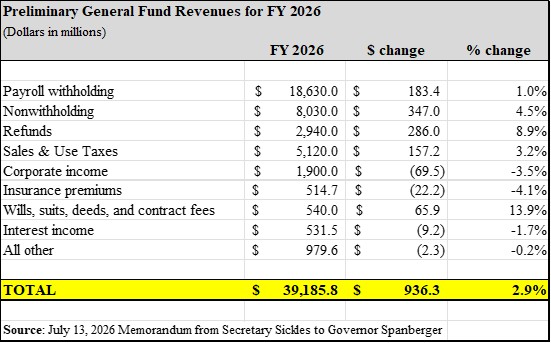
A little over a week ago, Secretary of Finance Mark D. Sickles advised Governor Spanberger that general fund revenues exceeded the December 2025 forecast by nearly $1.0 billion in the most recent fiscal year. To be precise, preliminary data suggests that excess revenues in FY 2026 were $936.3 million more than expected. In percentage terms, general fund revenues are 2.9 percent more than the official forecast.
That said, more than half of the recently reported surplus was not actually new. In fact, $585.5 million of the additional $1.0 billion in revenues were previously identified and built into the 2026-28 budget that was recently signed into law.
A summary of the preliminary totals for FY 2026 and changes can be found below.
While it is always positive to have ended the year in black, as opposed to the red, a few concerns emerge from these preliminary numbers.
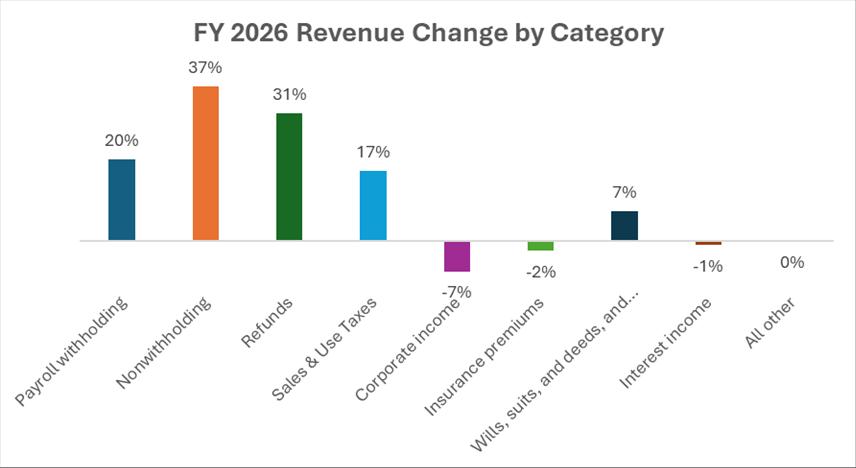
As shown in the chart below, revenues from nonwithholding and refunds, unpredictable revenues sources for Virginia, accounted for two-thirds of the excess dollars that flowed into the treasury in FY 2026. Contrast that with revenues from withholding and sales and use taxes, the bread and butter of the Commonwealth’s general fund revenues. Those categories only exceeded the forecast by 1.0% and 3.2% respectively. Admittedly, revenues from withholding and sales and use taxes are growing, but one could hardly say they’re growing robustly.
What the strength of all these revenue sources means going forward will be discussed in further detail when Governor Spanberger and Secretary Sickles brief the Joint Committee of House Appropriations, House Finance, and Senate Finance and Appropriations on these year-end revenue figures on Wednesday, August 19, 2026.
VML Contact: Joe Flores, jflores@vml.org
General Laws
Statewide Interoperability Executive Committee (SIEC) and Virginia Fire Programs meet
The SIEC met on Wednesday of this week and was honored to have Senator Digges and Public Safety Deputy Secretary Dillon Taylor, Esq in attendance. This group’s main topic was studying SB525 (Stuart) titled “Mutual aid agreements; public safety radio equipment.” This bill came to the SIEC with a letter asking the following questions:
- Consider whether any interoperability or frequency sharing approach should involve fire and EMS agencies along with law enforcement.
- Consider the challenges of sharing current mutual aid frequencies and what can be done to improve these frequencies along with reviewing current mutual aid agreements.
- Review system compatibility and technology diversity to include encryption; taking into account the National Interoperability Field Operations Guide and the National Law Enforcement Communication Center practices guide.
- Assess whether current statewide, regional or local frameworks are enough to address these issues of whether more policy guidance or statutory changes may be needed to ensure interoperability while protecting system integrity and public investments and if so, to offer recommendations to that end.
There was a lot of discussion on what practices are available and whether this should be a law or an attachment to the Statewide Communication Interoperability Plan (SCIP). There seemed to be consensus it should be an attachment to the SCIP. Other discussions were about encryption, cybersecurity, frequencies, etc. A draft plan will be circulated in the next few weeks for review by this group prior to adoption.
The group also created a subcommittee to review the SCIP and to plan the 3rd Annual Emerging Technologies Conference.
Virginia Fire Programs (VFP)
SB233 (Head) Fire Programs Fund; distribution of fund Study by Virginia Fire Programs (VFP)
This group met virtually last week for further discussion on this directive:
“That the Department of Fire Programs (the Department) shall establish a work group to evaluate the funding formula for the distribution of aid to localities through the Fire Programs Fund established in § 38.2-401 of the Code of Virginia. The work group shall include representatives from the Department of Planning and Budget, the Virginia Fire Services Board, the Virginia Fire Chiefs Association, the Virginia State Firefighters Association, the Virginia Professional Fire Fighters Association, the Virginia Association of Counties, the Virginia Municipal League, and such other stakeholders as the Department deems appropriate. In conducting the evaluation, the work group shall consider (i) a survey of the fiscal distress of each locality providing firefighting services, (ii) a survey of the population and total square mileage of each locality providing firefighting services, (iii) best practices and funding formulas employed by other states to fund firefighting services, and (iv) recommendations for changes to the funding formula for the distribution of aid to localities that more equitably address the needs of less populated and rural localities. The Department shall submit a report on the work group's findings and recommendations to the Chairs of the Senate Committees on Commerce and Labor and Finance and Appropriations and the House Committees on Labor and Commerce and Appropriations by November 1, 2026.”
The discussion at both VFP meetings thus far has included: that the current allocation is population, discussion of a proposed formula of 70% population and 30% land area (acknowledging there are winners and losers), a second proposed formula that assumes the fund would double in size, and other states’ methodologies.
A similar study in 2023 had the following language; “…..study existing fire service needs, analyze sustainability of funding, and review alternative funding models..”
Key Findings in 2023 were:
- Current funding is not sustainable
- Want a funding stream similar to HB599
- Raise the amount of funding for the Fire Programs Fund
- Statewide equipment and contract loans
The consensus of the group seems to be that if there is change it needs to be impactful and that any proposed change based on the current study’s language would not be impactful and in fact could harm some localities’ funding. Everyone involved feels an impactful change is necessary, but there is not a mechanism for doing so without more money. Members of the VFP are going to draft a report outlining this sentiment for review by the rest of the group in early August.
VML Contact: Michelle Gowdy, mgowdy@vml.org
Virginia Freedom of Information Advisory Council subcommittees meet
The meetings, records, and remedies subcommittees of the Virginia Freedom of Information Advisory Council (FOIA Council) met this past Tuesday and Wednesday. All three subcommittees discussed legislation referred from the most recent General Assembly session, with only the Remedies Subcommittee sending a bill for review by the full FOIA Council. The subcommittees all discussed scheduling one more meeting this year, tentatively in late August.
Meetings Subcommittee
The meetings subcommittee discussed HB463 (Cohen), which amends the definition of “meeting” for purposes of FOIA to allow a quorum of members of a public body to constitute a meeting. The current standard is a gathering of three or more members or a quorum, if the public body has fewer than three members, constitutes a public meeting. The bill additionally authorizes members of a public body participating through electronic communication in a meeting in which other members are participating in person to count toward the quorum should such member's physical absence be due to an approved cause of absence.
Finally, Senator Bennett-Parker presented for discussion bill language that would require localities to post agendas in advance of public meetings and state whether public comment will be received at the meeting. Under this proposal, localities would be required to post public meeting agendas prior to the meeting in the same locations where meeting notice is already posted, such as a website and other public locations. If your locality has comments about this proposal, please email Jessica Dennis, jdennis@vml.org.
The meetings subcommittee lacked quorum so did not take any formal action on the items discussed.
Records Subcommittee
The records subcommittee discussed HB313 (Wachsman), which would include non-residents owning real property in the Commonwealth among the list of persons to whom all public records shall be open under FOIA. The subcommittee requested various amendments to HB313, which will be evaluated during the subcommittee’s next meeting.
The subcommittee also discussed the impact of artificial intelligence (AI) generated FOIA requests and the burden these requests place on localities, such as the complexity of the request or the increase in inaccurate code references. Finally, the subcommittee received written reports regarding FOIA charges and the concept of defining “personal information” for the purpose of establishing a new exemption. The subcommittee asked for additional discussion of all three of these matters during a future meeting.
Remedies Subcommittee
The remedies subcommittee had in-depth discussion on two bills, HB159 (Simon) and HB160 (Simon). HB159 specifies that service of process or a summons for a hearing shall not be required when a petition for mandamus or injunction to enforce rights granted under FOIA has been filed. HB160 Specifies that civil penalties may only be imposed on officers, employees, or members of a public body in actions brought against them in their individual capacity for certain violations of FOIA. The bill further requires a court, when determining whether the FOIA violation(s) was committed willfully and knowingly, to consider certain mitigating factors, including good faith reliance on: (i) opinions of the Attorney General; (ii) court cases substantially supporting such officer's, employee's, or member's actions; (iii) advisory opinions of the Virginia Freedom of Information Advisory Council; and (iv) advice of counsel for the public body, as evidence that such officer, employee, or member did not willfully and knowingly commit such violation. Current law only authorizes a copy of a relevant advisory opinion issued by the Virginia Freedom of Information Advisory Council as a mitigating factor.
The subcommittee opted to send HB160 to the full FOIA Council to consider at their next meeting. The subcommittee will continue to work on HB159 during the next subcommittee meeting.
VML Contact: Jessica Dennis, jdennis@vml.org
Transportation
VDOT contemplates current asset conditions vs. construction funding
Virginia's cities and towns that maintain their own roads have already felt the impact of constrained maintenance funding with a 3.2% funding reduction this year after a one-time funding increase expired. This one-time funding expiration is impacting road maintenance funding statewide as the Virginia Department of Transportation (VDOT) is absorbing the same cut to statewide maintenance funds. As a result, the Commonwealth Transportation Board (CTB) is reconsidering how future maintenance is funded and determining the cost of maintaining current road quality.
“Maintenance and operations program costs are not keeping pace with actual costs” was the core message of a recent presentation by VDOT Commissioner Steve Brich this week. The Commissioner explained at great length – and in great detail – that inflation has continued to outpace revenues for transportation maintenance and paving in recent years. Since 2019 the cost of maintaining roads in Virginia has far exceeded expectations at that time and goals established in 2019 for VDOT maintained assets. Given these costs increases the CTB is reconsidering the current standards for pavement quality and whether to maintain those levels at the expense of future construction needs or reconsider these standards to free up funds for future construction projects.
Prioritizing the condition of existing roadways through increased maintenance funding will decrease future costs to restore degraded pavements and avoid costly reconstruction of roadways which would result in fewer construction projects able to be funded at a time when SMART Scale is already funding fewer projects with less money than previous SMART Scale cycles. Should the CTB choose to prioritize funding future construction projects more miles of interstate, primary and secondary roads will be in worse condition each year and restoring those pavements will be an increasingly costly task.
The VDOT Presentation can be found here >.
VML Contact: Mitchell Smiley, msmiley@vml.org
 VML News Board – Recent Posts
Please check the VML News Board (no password required) for the latest notices and opportunities for local governments, including recently added items such as: