eNews – March 6, 2026
Oppose HB1279/SB388, One percent local option sales tax for schools update, Budget conferees get to work...and more!
Friday, March 6, 2026/Categories: eNews

This edition of eNews is sponsored by Mattern & Craig providing comprehensive civil and sanitary engineering services to public, corporate and governmental agencies throughout Virginia, Tennessee, North Carolina and South Carolina. Learn more >
VML’s 2026 General Assembly resources can be found on our website here >.
In this issue:
Action Alerts
Budget
Cannabis
Photo Speed Enforcement
Senate Commerce and Labor Committee
Senate Courts of Justice Committee
Senate & House Courts of Justice Committees
Senate Finance and Appropriations Committee
House Labor and Commerce Committee
VML News
Opportunities
Action Alerts
OPPOSE: HB1279 / SB388 would make monumental changes to land use policy
HB1279 (Cole, J.G.) / SB388 (McPike) Affordable housing; religious organizations and other nonprofit tax-exempt properties.
What these bills do:
HB1279 / SB388 require the administrative approval of development and construction on certain tax-exempt properties to include religious organizations if the locality has adopted a zoning ordinance. Mixed-use or residential projects shall be permitted by-right, if there is an existing water and sewer line within 500 feet of the property. For example, a building could be as high as 45 feet high and have retail businesses operating in them despite being non-profits! In addition, only 60% of the units have to be affordable.
Reasons to OPPOSE HB1279 / SB388:
- Allow certain non-profit organizations and religious organizations to build by-right housing on their property.
- Strip local zoning authority and undermine comprehensive planning.
- Neighbors of these properties will not have the ability to provide input – only an administrative approval is needed.
- Fail to account for water and sewer capacity – only proximity.
- Very prescriptive rules about height and size with no discretion.
Action Requested:
Please contact the Senate and House conferees (below) and ask them to OPPOSE AND/OR SUPPORT REENACTMENT FOR HB1279 / SB388.
Senate Conferees:
House Conferees:
VML Contact: Michelle Gowdy, mgowdy@vml.org
UPDATE: Zoning by right bills HB816 and SB454 unlikely to become law this year
We are pleased to report that HB816 (Helmer) was defeated in the Senate this week and SB454 (VanValkenburg) is in the Counties, Cities and Towns Committee which met for the last time today so it is seemingly gone as well. As such, we believe both bills will not become law this year.
As you recall these bills deal with zoning; by-right multifamily residential development in areas zoned for commercial use.
Thank you to everyone who sent letters and emails to help reshape the posture of these bills!
VML Contact: Michelle Gowdy, mgowdy@vml.org
Budget
One percent local option sales tax for schools included in the budget; Support inclusion of debt servicing option
One of VML’s recent top legislative priorities has been a local option sales and use tax of up to one percent dedicated to school construction. Throughout the 2026 General Assembly session, VML supported all bills granting this authority. The House bill, HB334 (Rasoul), passed the House 70 to 28 but has not been heard in the Senate. The Senate versions were left in Senate Finance and Appropriations Committee with no action taken.
Fortunately, the language allowing this expanded authority has been included in the Senate’s budget! However, the version included in the Senate’s budget differs from the agreed upon version that passed the House. It does not include debt services as eligible uses of the money generated from the sales tax and has stakeholder agreement and input.
We encourage our members to use VML’s one pager (available here) to advocate for the inclusion of debt services language in the budget.
VML Contact: Josette Buolva, jbulova@vml.org; Michelle Gowdy, mgowdy@vml.org
House and Senate budget conferees have work to do
Early Friday, Governor Spanberger convened the House and Senate budget conferees for breakfast at the Executive Mansion. To be sure, it wasn’t a confab to merely discuss the beautiful March morning or share pleasantries about how the 2026 Session is proceeding.
No, on the eve of budget discussions, it’s customary for the governor to assemble the General Assembly’s budgeteers responsible for negotiating a final deal to provide direction about what she’d like to see in a final agreement.
The substance of that conversation is as elusive as the menu for the brunch.
No doubt there were conversations about the disparate bottom lines separating the House and Senate budgets. And by “disparate”, we mean the billion dollars that separate the resources and thus expenditures reflected in the House and Senate budgets. The delta is explained primarily by the Senate’s decision to sunset a general fund exemption from the retail sales and use tax that has been afforded to data centers for more than a decade.
Estimated to cost the general fund $1.0 to $2.0 million during the 2008-10 biennium, the price tag for this economic incentive to data centers has ballooned to more than $1.6 billion annually at present, as the Commonwealth has become the mecca for such entities. Whether the conferees decide to put a stop to these tax exemptions along the line of the Senate’s proposal or leave them intact (the House’s approach) will dictate how much funding is available for various initiatives.
Whether Governor Spanberger weighed in on that policy difference in the House and Senate budgets is unknown at this point, but putting her thumb on the scale at this moment would be a sensitive fiscal matter with lots of money on the line.
As an aside, one cannot miss the irony that localities are also attempting to address the exponential growth of a tax exemption enacted around the same time as the data center exclusion, namely the mandatory property tax exemptions for veterans and their families. Like the data center exemption, the cost of the veterans’ property tax exemption was also originally projected to be minimal; it is currently projected to exceed $400 million in 2026.
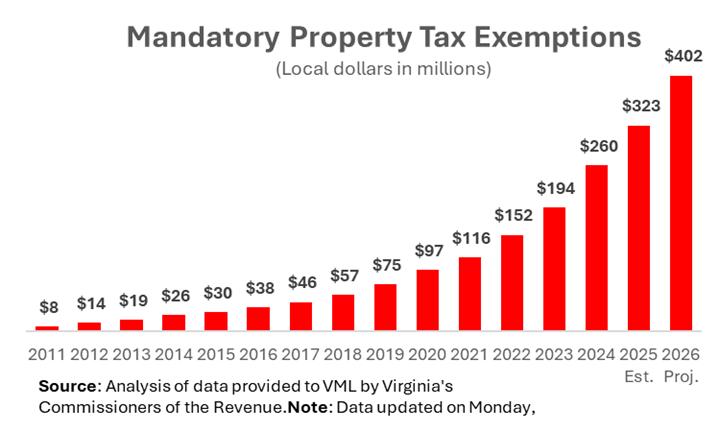
It’s important to note that local governments are not looking to sunset the program; rather, we are simply looking for a review to understand the growth of the exemptions, implications for localities, and options for relief from the Commonwealth. The House has included an amendment (Item 1 #5h – Legislative Workgroup on Property Tax Exemptions) to do just that in their budget, while the Senate has not. Hopefully we can get some agreement on this issue.
VML Contact: Joe Flores, jflores@vml.org
Cannabis
Cannabis bills in conference
HB642 (Krizek) and SB542 (Aird) are in a committee of conference to resolve differences between the bills. Both bills include local taxation and land use/zoning authority for retail sales and dispensaries. Conference committee members are Senators Aird, VanValkenberg, Rouse, and Head and Delegates Krizek, Herring, and Morefield.
VML Contact: Mitchell Smiley, msmiley@vml.org
Photo Speed Enforcement
Photo speed bills still in play
This week Senate and House Committees took final action on photo speed enforcement legislation with many bills, particularly those that sought to expand where photo speed devices could be used, failing to advance for further consideration. It is not yet clear if all the remaining bills will advance for further consideration by the governor.
Those still in play are summarized below.
SB84 (Williams Graves) Speed safety cameras; placement and operation; violation enforcement; civil penalties. Requires any funds collected from a photo speed enforcement program be used for specific roadway and pedestrian projects as defined in the bill, requires workers to be present for a summons to be issued in a photo enforcement work zone, directs the Virginia Supreme Court to develop a uniform summons for photo speed enforcement violations, each mailing of a summons must also include information to contest the summons, requires photo enforcement device be calibrated in the same manner as other speed detection devices and requires that calibration data to be provided for anyone contesting the summons within 10 days of a request for the data and establishes a fine for vendor non-compliance, limits administrative fees that vendors can collect.
SB219 (Jones) Photo speed monitoring devices; summons; reports. Incorporates HB1220 in addition to requiring two summons for photo speed enforcement violations and directing the commissioner of VDOT to pause any registration until a summons issued under a photo speed enforcement program is paid.
SB436 (Bagby) Photo speed monitoring devices; highway work zones; workers present. Incorporates HB1220 and requires workers be present for a summons to be issued by a photo speed enforcement device
HB684 (Hayes) / SB59 (Diggs) Photo speed monitoring devices; photo-monitoring systems for traffic signals; proof of violation; registered conservators of the peace and technicians employed by a locality; training. Authorizes training for photo speed monitoring devices to be developed and provided by the Department of Criminal Justice Services and authorizes special conservators of the peace to review photo speed monitoring footage and issue summons as part of a photo speed enforcement program.
HB1220 (Delaney) Photo speed monitoring devices; placement and operation. This bill is focused on adding additional requirements for localities to operate a photo speed enforcement program. This bill is focused on adding what are being referred to as guard rails to these programs in line with what the Virginia Crime Commission recommended after studying photo speed programs in 2025.
HB1220 directs the Supreme Court of Virginia to develop a uniform summons for photo speed enforcement violations by October 1, 2026. Localities must use the summons developed by the Supreme Court of Virginia by January 1, 2027.
HB1220 requires local photo speed programs to do the following:
- Use two signs alerting drivers of a photo speed device one of which must be a photo speed feedback display sign (delayed enactment date of July 1, 2027).
- Include a 30-day warning period for any new photo speed monitoring devices installed after July 1, 2026.
- Publish information online by the relevant law enforcement agency on contesting violations, establish a process for answering questions related to photo speed enforcement devices, publicize information regarding the location of photo speed devices including any new locations.
- Develop an emergency action plan by the law enforcement agency to manage equipment malfunctions in accordance with federal guidelines including an annual review of how systems address safety needs, racial, economic and other equity issues and public concerns.
HB1220 also does the following:
- Establishes new annual reporting requirements and dates requiring localities to report data to the Virginia State Policy by November 15 of each year and report on projects funded by moneys in the local fund collected from photo speed violations, the change in summons issued over the reporting period, the number of unsuccessful prosecutions and dismissed summons, the percentage of vehicles that receive a summons relative to total vehicle throughput.
- Establishes a new standard and review process for localities that operate a photos speed enforcement program in willful disregard of statutory authority with penalties to be determined by a judge to include attorney and court fees as well as the possibility to lose any fines or fees collected under a photo speed program to the Virginia Highway Safety Improvement Program.
- Establishes a new data retention standard of no more than 21 days after a summons is not issued or a summons is resolved.
- Requires workers to be present in highway work zones for photo speed enforcement to operate.
- Requires localities deposit any revenues in excess of what is necessary to operate a photo enforcement program in a fund to only be used for specific roadway improvements as set out in the bill and prioritize for projects in zones where photo enforcement is used.
HB1220 requires vendors to:
- Calibrate photo speed devices to the same standard and frequency as other devices that are used to determine speed and provide this data upon request to any person who has received a summons postmarked or sent electronically within 10 days of receiving a request. The summons must include information on how to request. Failure to comply can result in a fine up to $1,000
- Include verification that workers were present in any work zone where a summons was issued under a photo enforcement program.
VML Contact: Mitchell Smiley, msmiley@vml.org
Senate Commerce and Labor Committee
Collective bargaining bill for public employees heads to SFAC; Lobbying bill for local governments needs a lot of work; Conveyances of property bill heads to HAC
HB1263 (Tran) Collective bargaining by public employees; individual home care providers; Virginia Home Care Authority established; Public Employee Relations Board established; exclusive bargaining representatives. Requires all local governments to recognize unions for collective bargaining. Continues the existing law that prohibits public employees from striking. The Senate Commerce & Labor Committee reported the bill today and referred it to the Senate Finance and Appropriations Committee. VML opposes the bills as they will cost local governments hundreds of millions of dollars.
SB50 (Rouse) Lobbying; registration; local governments; penalty. Expands the definition of lobbying to include influencing or attempting to influence local government. The House General Laws Committee reported a revised version. The revisions improve the bill slightly, but VML continues to oppose it because it could cause confusion and uncertainty with local government employees.
SB334 (Roem) Conveyances of interests in real property; public hearing required. This bill requires that a public hearing be held whenever a locality is planning to sell land or convey a permanent easement or right-of-way for 1. major transmission lines over 69 kilovolts, 2. data center utilities and power lines serving the center over 69 kilovolts, and 3. power lines over 69 kilovolts for any commercial or industrial facility. The bill prescribes that the advertising and hearing be done in accordance with the rules for land use actions (two ads). The House Counties, Cities and Towns Committee reported the bill and referred it to the House Appropriations Committee.
VML Contact: Mark Flynn, markkflynn@gmail.com
Senate Courts of Justice Committee
Vested rights for zoning bill reports; Law-enforcement duty to render aid bill remains
SB504 (Deeds) Vested rights; rulings or orders of the local circuit court. This bill redefines vested rights in certain situations by adding a rule that a court order concerning the rezoning of more than 25 parcels would affect the rights of a landowner, the landowner’s rights remain vested, so long as it is pursuing a project in a manner that otherwise establishes that the owner’s rights are vested. SB504 passed out of the House Counties, Cities and Towns Committee this morning (March 6). HB1122, a similar vested rights bill was carried over in that committee.
HB273 (Helmer) Law-enforcement officers; duty to render aid upon danger to life or limb; civil immunity. Provides that a law-enforcement officer, while engaged in the performance of his duties, has a duty to render aid to any person that he observes suffering from a serious bodily injury or life-threatening condition as circumstances objectively permit. The bill provides immunity for such officers from civil liability for any acts or omissions that are not due to gross negligence or willful misconduct resulting from the rendering of such aid. The bill has yet to be heard by the Senate Courts of Justice Committee.
VML Contact: Mark Flynn, markkflynn@gmail.com
Senate & House Courts of Justice Committees
VASAP bills amended again and moving on
HB862 (Cousins) and SB391 (Stuart), companion bills which address the operations of the Virginia Alcohol Safety Action Program (VASAP), community-based Alcohol Safety Action Programs (ASAPs) and potentially tags local governments with responsibility for funding components of this state-mandated program continue to make their way through the General Assembly.
Both bills have been amended a few times over the last several weeks and appear to be moving toward final adoption.
Today the House accepted the Senate substitute for HB862. The substitute proposed by House Appropriations to SB391 was on second reading in the House. The substitutes adopted by the money committees put the bills in the same stance.
Those changes most recently made by the money committees primarily addressed the make-up of the workgroup created in enactment clauses in each bill. These changes remove both the Secretary of Health and Human Resources and the Secretary of Public Safety/Homeland Security from the proposed workgroup at their request (the HHR Secretary had originally been proposed to chair the workgroup). Instead, VASAP will staff the workgroup, which is less than ideal. VML and VACo remain on the workgroup, along with staff of the House and Senate budget committees and VASAP/ASAP reps. The workgroup will still examine the funding and operations of VASAP and its community-level ASAPs given the growing funding gaps in this fee-based program. VML had sought the workgroup in reaction to the originally proposed language mandating that local governments (cities, counties and towns) help fund the program and serve as fiscal agents.
The bills still contain language regarding local contributions and fiscal agent responsibilities, but amendments proposed by VML and VACo delay enactment until Jan. 2028, after the workgroup completes its findings and recommendations.
VML opposes mandatory local financial support of this state program and the mandated local fiscal agent requirement; VML supports the workgroup to look more carefully at the program’s finances and options for other funding sources, such as state non-general or general fund support since it is a state program.
VML Contacts: Joe Flores, jflores@vml.org; Janet Areson, jareson@vml.org
Senate Finance and Appropriations Committee
Funding for regional special education programs bill continued to next year
Senate Finance & Appropriations continued to next year HB1373 (Carroll), which would require the Department of Education, the Office of Children's Services and others, to assess ways to maximize use of funds in the Students with Intensive Support Needs Application (SISNA) program, with the goal of serving more children in a public school setting and decrease the number placed in private day special education programs. In continuing the bill, Senator Mamye Locke said that this issue would be addressed in the budget.
There are Senate and House amendments adopted in each respective budget that address use of SISNA and either increase funding to the program (Item 125 #4h) or direct VDOE to recommend ways to remove barriers to its use and streamline the process (Item 118 #1s).
VML supports both these amendments.
VML Contact: Janet Areson, jareson@vml.org
House Labor and Commerce Committee
Costly collective bargaining bill reports; Prevailing wage for public works bill no longer includes local governments
SB378 (Surovell) Collective bargaining by public employees; individual home care providers; Virginia Home Care Authority established; Public Employee Relations Board established; exclusive bargaining representatives. Repeals the existing prohibition on collective bargaining by public employees. The bill creates the Public Employee Relations Board, which shall determine appropriate bargaining units and provide for certification and decertification elections for exclusive bargaining representatives of state employees and local government employees. The bill requires public employers and employee organizations that are exclusive bargaining representatives to meet at reasonable times to negotiate in good faith with respect to wages, hours, and other terms and conditions of employment. The fiscal impact is shown to reach hundreds of millions of dollars. The bill was reported by the House Labor and Commerce Committee earlier this week. VML opposes the bill as a costly impact on many localities.
SB518 (Rouse) Prevailing wage rate for public works contracts; localities. The bill originally required that all contractors providing services to localities must pay the prevailing wage for employees if the work is supported in whole or part by state funds. HB569, (Feggans), a similar bill was amended to remove localities from the requirement. The Senate Commerce and Labor Committee accepted the HB569 approach Monday, so local governments are no longer included in the legislation.
VML Contact: Mark Flynn, markkflynn@gmail.com
VML News
More than 50 localities have yet to comply with financial reporting requirements
Please respond as soon as possible!
Two weeks ago, the Auditor of Public Accounts (APA) Staci Henshaw, sent a letter to members of the Joint Legislative Audit and Review Commission (JLARC), apprising them that 54 localities have neglected to provide mandatory financial reporting data by February 15, 2026, two months after the statutory deadline. The required information includes a locality’s detailed statement of revenues and expenditures and their annual audited financial statement.
Data provided by cities, counties, and towns, is compiled in the APA’s annual Comparative Report of Local Government Revenues and Expenditures, also referred to as the Local Comparative Report. The local financial figures provided to the APA are not only required by the Code of Virginia but provide a wealth of critical fiscal information that VML staff regularly use for analytical work and to provide context when responding to related queries.
The APA notified local governments that they have until mid-March to respond to ensure inclusion of their locality’s data in the final report that will be published in April 2026. It’s important that localities complete this assignment as soon as possible and keep the APA in the loop about any delays.
Additional details about this statutory requirement can be found in § 15.2-2510 of the Code of Virginia.
VML Contact: Joe Flores, jflores@vml.org
 Small Towns Conference and “Local Workshop” coming to Chincoteague May 13-15
The Small Towns Conference provides an overview of topics related to local government management specifically geared towards small town issues. This conference invites elected officials, including council members and mayors, town managers, and leadership staff to learn, network, and share resources and ideas.
This year the Small Towns Conference will be held May 14-15 at the Chincoteague Center.
Lodging options, registration, and more information about the 2026 Small Town’s Conference is available on VML’s website here.
Pre-Conference Offering – May 13
We know that Chincoteague is a bit of a drive for many of our members, so for those arriving early there will be a special afternoon of programming on May 13 beginning at 1:00pm followed by a reception that evening. Please join us if you are able!
Local Workshop: Tools & Materials for Building Communities
What are the tools and materials used for building and revitalizing communities? How can you make informed decisions that positively affect the growth of your community? This interactive workshop will provide a better understanding of the many components of community building, such as zoning & land use, transportation, historic preservation, placemaking & open space planning, and economic development.
VML Contact: Rob Bullington, rbullington@vml.org
 “If I Were Mayor” essay contest open to 7th and 8th graders
Deadline to submit entries is March 23
The Virginia Municipal League (VML) invites all eligible Virginia 7th and 8th Graders to join its “If I were Mayor” essay contest.
Regional winners selected from around the state will each receive a $150 gift card and a plaque. One statewide winner chosen from the regional winners will receive a $250 gift card and a plaque. The runner-up from the region that receives the statewide award will become that region’s winner.
Winning essays will be featured in the May/June issue of VML’s magazine Virginia Town & City.
Learn more about the contest and how to submit entries here >.
VML Contact: Manuel Timbreza, mtimbreza@vml.org
Opportunities
Free webinar March 25: Continuing education for law enforcement and public safety professionals
Join VML Community Business Member organization* American Military University (AMU) for Education in Action: An AMU Alum Spotlight, a live webinar for law enforcement officers and public safety professionals.
*AMU is part of the American Public University system.
During this session, AMU alumnus Henry J. Giammarco, Jr., Chief of Police for the Yeadon, Pennsylvania Police Department, will share his career journey and how his AMU education helped him reach his goals in public safety.
- Date: Wednesday, March 25, 2026
- Time: 2:00 PM EST
- Registration: Register here >
What you’ll learn:
- How AMU's flexible online format fits into the life of a working public safety professional
- Ways to save on career-relevant education
- How education can support your career goals
Promotional flyer available here >.
Save your spot today to hear one professional’s experience firsthand.
AMU Contact: Matt Hoffman, mhoffman@apus.edu
Main Street Now 2026: Discounted rate for civic leaders
Civic leaders can attend the 2026 Main Street Now Conference in Tulsa, OK (April 13-15) for as little as $200. The civic leader rate also includes tailored content, special sessions, and invaluable network-building opportunities.
This is a professional development opportunity for civic leaders looking to boost their impact and role in the success of their local Main Street:
- Connect with hundreds of elected officials and government administrators from across the county
- Explore proven strategies and innovative solutions to address pressing issues in communities of all sizes — choose from 100+ sessions, including a curated civic leaders education track
- Learn strategies for building durable Main Streets through civic leader support at this year's Civic Leaders Forum, featuring a dynamic panel discussion with local Oklahoma officials:
- Heather Turner, Deputy CEO, Oklahoma Department of Commerce and Executive Director, CORE
- Representative Mark Lawson, Majority Leader, Oklahoma House of Representatives
- Canaan J. Duncan, Deputy Secretary of State, Cherokee Nation
- Anthony Archie, Councilor, District 2, Tulsa City Council
- Kelsey Wagner, Mayor, Ponca City
SIGN UP HERE >
DETAILS:
- When: April 13-15, 2026
- Where: Tulsa, Oklahoma
- Civic Leader Rate: $200 online (open through April 6), $299 on-site
- Who Qualifies: Elected officials and senior government staff, including mayors, county executives, city councilmembers, elected municipal leaders, staff at the director level and above in Main Street-related departments (i.e., economic development, planning, historic preservation, etc.).
Have questions? FAQs available here >
Main Street Contact: info@mainstreet.org. Kindly allow up to 72 hours for a response.
Virginia Coastal Resilience Collaborative: Free workshop in Williamsburg April 21
The Virginia Coastal Resilience Collaborative is hosting a free workshop on Tuesday, April 21 for a workshop discussing NOAA’s updates to geodetic vertical datums and tidal datums.
Vertical datums are the baseline standards from which we derive land elevation and marine-based measurements like mean low water, mean high water, and mean sea level. NOAA and the National Geodetic Survey are in the process of updating vertical and tidal datums. Several of these derived measurements are addressed in state a local government codes and ordinances.
This workshop will focus on a project funded by NOAA through the Virginia Coastal Zone Management Program, where references to tidal datums, vertical datums, and their derived measurements were catalogued and assessed for potential impacts from pending updates.
Topics will include background on datums and their use in state and local codes in Virginia; how the VCRC, VIMS, and CBNERR-VA approached this research and catalogued references; the results of an analysis of these changes on Virginia state and local laws; and discussion on possible ways to address these impacts.
The workshop will be held from 9:30am to 1:00pm at William & Mary’s School of Education at 301 Monticello Ave, Williamsburg, VA 23185. Registration is free and lunch will be provided. Following various presentations on aspects of the project and preliminary conclusions, ample time for discussion is built in to garner feedback on next steps and address questions. We encourage you to share this event with your networks, particularly state and local government officials and employees, and planning district commissions who will see the most impact from these updates.
REGISTRATION: You can use this link to register for the workshop.
FLYER: A PDF promotional flyer is available here >.
AGENDA: A PDF of the workshop agenda is available here and on the VCRC website.
Virginia Coastal Resilience Collaborative Contact: Thomas Ruppert, tkruppert@wm.edu
NeighborWorks Ground-Up Emerging Developers Training in Richmond: March 30 - April 3
Virginia Housing is proud to partner with NeighborWorks America to host the NeighborWorks Ground-Up Emerging Developers Training in Richmond from Monday, March 30 - Friday, April 3.
This multi-day professional development experience is designed to support aspiring affordable housing developers across the Commonwealth. The training will feature industry experts who will give emerging developers the tools, strategies and technical knowledge needed to deliver successful, sustainable affordable housing projects.
Topics include strategic thinking, building a development team and progressing from initial concept to final blueprint.
Registration is required to attend, and capacity is limited!
Register and View Trainings here >.
Virginia Housing Contact: Housingeducation@virginiahousing.com
Registration now open: Salute to Service honors Virginia Veterans at Virginia War Memorial, March 21
When: Saturday, March 21, 2026 10:00 a.m. to 6:00 p.m.
Where: Virginia War Memorial (621 South Belvidere Street | Richmond, VA 23220)
Registration is now open for all Virginia Veterans and those who support them for the inaugural “Salute to Service Reunion Celebration” a day-long program of remembrance, honor, and reconnection.
Highlights of the event include the premiere of Decisive Victory: Operation Desert Storm, a new documentary produced in partnership with Blue Ridge PBS, a wreath-laying ceremony honoring the seven Virginians killed in action in this conflict, unit rally points, musical performances by the West Point Alumni Glee Club, and a panel discussion offering firsthand perspectives on the Operation Desert Storm conflict and its lasting legacy.
Panelists include:
- James Henry Binford “Binnie” Peay III, General, USA (Ret.)
- John P. Jumper, General, USAF (Ret).
- Barry R. McCaffrey, General, USA (Ret.)
- Robert B. Flowers, Lieutenant General, USA (Ret.)
- Michelle Rose, Major General, USA (Ret.)
- Moderated by Michael S. Bell, Colonel, USA (Ret.), Executive Director of the Institute for the Study of War and Democracy at the National WWII Museum.
The 2026 gathering marks the first veteran reunion of its kind hosted at the Virginia War Memorial and launches the Salute to Service Reunion series, a multi-year program with future reunions planned for Vietnam War veterans in 2027, Global War on Terrorism veterans in 2028, and Cold War–Fall of the Berlin Wall veterans in 2029.
The event is free to attend for Operations Desert Shield and Desert Storm Veterans and a guest. Additional guests and supporters are $25 to attend. Advance registration is required as space is limited.
MORE INFO AND REGISTRATION HERE >
All program fees support the Salute to Service Reunion Celebration.
Contact: info@vawarmemorial.org