eNews – January 23, 2026
Money committees ramp up oversight, All the bills in committees to watch, New resources for localities ...and more!
Friday, January 23, 2026/Categories: eNews

This edition of eNews is sponsored by Dominion Energy investing in the communities where we live and work, and striving to protect our natural resources while delivering safe, reliable energy to our customers.. Learn more >.
VML’s 2026 General Assembly resources can be found on our website here >.
In this issue:
Finance News
Senate Transportation Committee
House Finance Committee
Senate Finance and Appropriations Committee
House and Senate Rules Committees
Senate Local Government Committee
Senate General Laws Committee
House Counties, Cities and Towns Committee
House General Laws Committee
House General Laws - Subcommittee #5
Senate Rehabilitation and Social Services Committee
Senate Education and Health – Public Education Subcommittee
Senate Rehabilitation & Social Services Committee
Senate Courts of Justice Committee
House Courts of Justice Committee
Senate Commerce and Labor Committee
House Labor and Commerce Committee
VML News
Resources
Opportunities
Finance News
Oversight by money committees kicks into high gear as warning signs emerge on future revenue growth
Earlier this week, Secretary of Finance, Mark D. Sickles, made his initial appearance in front of the House Appropriations (HAC) and Senate Finance and Appropriations Committees (SFAC). Not surprisingly, he was welcomed back with applause in HAC, a committee that he served on for many years and was a lead negotiator on budget issues for the House, especially matters related to health and human services.
Delivering the monthly revenue report for December, he acknowledged that general fund revenues were robust during the last month of 2025. Revenues are running nearly $400 million above the forecast through December (and that’s a good thing).
But warning signs are also flashing, he advised. He pointed out that while employment growth was positive for the year, the last six months have been negative. Layoffs and economic instability, particularly in northern Virginia, have contributed to sluggish growth with spillover effects in many communities across the region.
He also indicated that while December’s revenues from withholdings, taxes from wages and income were up 11.3% for the month, year to date tax withholdings are down by 1.7%. That’s a troubling sign that will need to be heeded as lawmakers begin to craft their responses to the introduced budget in the weeks to come.
As the staff from the money committees provided their members with an overview of former governor Youngkin’s introduced budget, they also began to drill down on specific budget issues in their respective areas. It was encouraging to hear the staff of the HAC and SFAC acknowledge that a sizeable hole in the Department of Social Services budget was left when the budget was rolled out. Staff also quantified the size of the hole – more than $200 million potentially – as a result of assuming that the Commonwealth would be able to cut its 11.5% SNAP error rate below 6.0%, in order to eliminate any federal cost-sharing.
In an environment where general fund revenues are likely to be scarce, it remains to be seen whether the money committees will be able to address the hole created in DSS's budget for SNAP.
Below you will find several useful documents that have been prepared by the staff of the House Appropriations and Senate Finance and Appropriations Committees to get a blow-by-blow rendering of former governor Youngkin’s introduced budget, including additional helpful context.
HAC:
SFAC:
VML Contact: Joe Flores, jflores@vml.org
VML and VACo request budget amendment to review the growth of mandatory property tax exemptions
As it relates to the budget, the cost of exempting disabled veterans and their spouses from local property tax rolls continues unabated, even as lawmakers continue to push for more exemptions. Based on an analysis of recent data collected by Virginia’s Commissioners of the Revenue, VML staff estimates that the cost of these unfunded mandates surpassed $300 million in 2025 and is projected to approach $400 million in 2026 (see chart below).
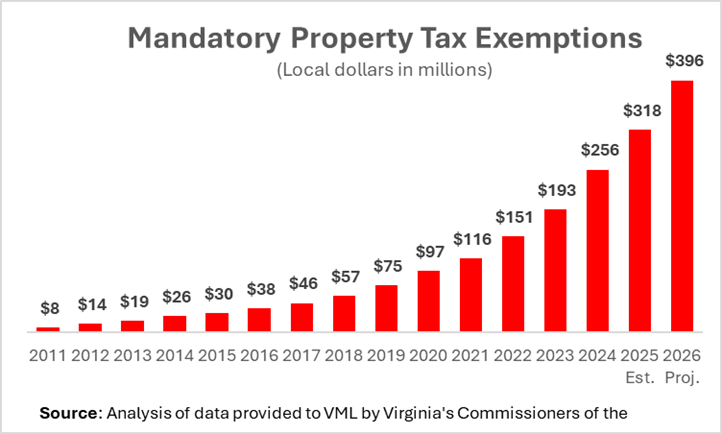
While on average the cost of these mandatory exemptions grew by 24% in 2025, compared to the prior year, some localities experienced extraordinary growth during the year. In fact, eleven localities experienced more than 40% growth in the program’s cost to their locality in 2025 (see table below).
|
Increase in Mandatory Property Tax Exemptions from 2024 to 2025
|
|
Locality
|
% growth
|
Locality
|
% growth
|
|
Appomattox
|
40%
|
Bristol (city)
|
53%
|
|
Charlottesville (city)
|
41%
|
Dinwiddie
|
41%
|
|
Fairfax (city)
|
90%
|
Isle of Wight
|
47%
|
|
Lee
|
54%
|
Norton (city)
|
81%
|
|
Poquoson (city)
|
51%
|
Radford (city)
|
66%
|
|
Suffolk (city)
|
64%
|
|
|
|
Source: Analysis of data provided to VML by Virginia’s Commissioners of the Revenue.
|
We’ve increasingly heard from localities across the Commonwealth that the cost of these decisions by lawmakers and, ultimately, the voters, is forcing local elected officials to sacrifice other needs in their community, whether it be optional relief to the elderly and disabled, more funding for K-12, or lower taxes.
We understand that general fund revenues are likely to be in short supply. So rather than ask for funding, we asked Senator Mamie Locke of Hampton and Delegate Josh Thomas of Prince William to patron amendments to establish a joint subcommittee of the House Appropriations and Senate Finance and Appropriations Committees to examine the growth of the program and come up with findings and recommendations to ensure the program is sustainable in the future. They both agreed, and we are extremely grateful for their support. A link to the amendments is provided below.
VML Contact: Joe Flores, jflores@vml.org
Senate Transportation Committee
OPPOSE: Bills would repeal local authority to operate automated traffic enforcement systems
SB297 (Peake) Use of photo speed monitoring devices; repeal. Repeals local authority to operate a photo speed enforcement program and eliminates current photo enforcement programs.
This bill advanced out of the Senate Committee on Transportation on a bipartisan vote of 8-7 advancing to the floor to be acted upon by the Senate of Virginia.
SB306 (Peake) Use of violation monitoring systems to enforce traffic light signals and certain traffic control devices; repeal. SB306 repeals local authority to operate a photo enforcement program for red lights, traffic light signals and traffic control devices entirely.
This bill advanced out of the Senate Committee on Transportation on a bipartisan vote of 8-7 advancing to the floor to be acted upon by the Senate of Virginia.
VML is opposed to SB297 and SB306. Please see our Action Alert from earlier today for more information.
VML Contact: Mitchell Smiley, msmiley@vml.org
Photo speed and monitoring bills advance from committee; Higher education school zones bill fails to advance
Advanced to full Senate
SB59 (Diggs) Photo speed monitoring devices; photo-monitoring system for traffic signals; proof of violation; certain persons swearing to or affirming certificates; training. Directs the Department of Criminal Justice Services to create training for certifying photo speed enforcement violations and further authorizes special conservators of the peace who are certified by DCJS and employed by the locality to affirm photo speed violations in addition to law enforcement and retired law enforcement officers employed by the locality currently authorized to affirm photo speed violations. This bill advanced unanimously from committee to be acted upon next by the Senate of Virginia
SB150 (New Craig) School bus video-monitoring systems; enforcement; sworn or affirmed certificates. Authorizes a retired sworn law enforcement officer to swear and affirm a summons for automated bus enforcement violations. This bill advanced unanimously from committee to be acted upon next by the Senate of Virginia.
SB436 (Bagby) Photo speed monitoring devices; highway work zones; workers present. Requires evidence or documentation verifying workers were present for photo speed violations issued in work zones. This bill advanced out of committee to the floor to be acted upon next by the Senate of Virginia.
Advanced to next committee
SB219 (Jones) Photo speed monitoring devices; civil penalties; summons; reports. This bill was amended in committee to require the issuance of a second summons for photo speed violations should the summoned person fail to appear. Should the recipient of a summons fail to appear for the second summons the court must notify the Department of Motor Vehicles to halt the issuance of any vehicle registration until civil penalties and fines are paid before registration can be reinstated. This bill was amended to remove language directing fines and fees collected by the Virginia State Police to the locality instead of the literary fund. This bill was reported unanimously from committee and will be heard next in the Senate Committee on Finance and Appropriations.
Failed to advance from committee
SB428 (Jones) School crossing zones; institutions of higher education. Allows institutions of higher education to be designated as school zones. This bill failed to advance from committee. VML supports this bill.
VML Contact: Mitchell Smiley, msmiley@vml.org
House Finance Committee
One percent local option sales tax for schools bill clears full committee
SB334 (Rasoul) Additional local sales and use tax to support schools; referendum. Would allow all cities and counties to impose a sales and use tax of up to one percent dedicated solely to school construction if approved by voter referendum. This bill passed out of the full House Finance Committee on a vote of 15-5
VML Contacts: Josette Bulova, jbulova@vml.org; Michelle Gowdy, mgowdy@vml.org
BPOL tax deduction for businesses makes an unexpected return
Harkening back to last year, one of the bills that we spent the most time on during the 2025 Session was HB1743 (Watts) License tax, local; work group to review deduction for receipts attributable to out-of-state. The bill, as introduced, expanded the existing BPOL licensing tax deduction for businesses operating in other states. But because the change was likely to result in an unknown revenue loss to local BPOL revenues, the bill was referred for study during the interim.
That review, led by the Department of Taxation, noted:
“While the participants engaged in frank and productive discussion, no consensus was reached to an extent that would permit the Department to make any recommendations in this report (emphasis added) except that consistency, clarity, and fairness are all vital to the administration of BPOL and should be central to any action taken to change the deduction administratively or legislatively. On a broader level, all participants in the work group seem to support clarity in the statute and consistency in its interpretation, fairness for multi-jurisdictional businesses, and solutions that would ease the administrative burden related to both the enforcement and compliance sides of the deduction.”
A link to the full report is available here.
Despite those findings, the concept is back for 2026 in HB956 (Watts) License taxes; deduction for out-of-state receipts. While VML continues to review the bill, which is only marginally different than what was proposed last year, preliminary feedback from localities indicates that the bill is still likely to have a significant negative impact on local revenues. Further, it’s expected that the bill will create significant administrative complexities and impose an undue burden in enforcing compliance.
If your locality has concerns about this bill, please relay them to your delegate as well as the VML staff person listed below, as soon as possible. The bill is scheduled to be heard in House Finance Subcommittee #2 at 4:30 pm on Tuesday, January 27, 2026. We haven’t spoken to the patron yet, but it’s unlikely that we can support this bill.
VML Contact: Joe Flores, jflores@vml.org
Senate Finance and Appropriations Committee
Giving localities authority to tax nicotine vapor products being considered
SB712 (Stuart) Tobacco products tax; local tax authority; nicotine vapor products. Gives localities the authority to impose taxes on the sale or use of nicotine vapor products. The tax could not exceed the lesser of the rate of 10 percent of the wholesale price or eleven cents ($0.11) per milliliter for the nicotine vapor product. Further, the bill provides the authority if approved by ordinance for the administration and enforcement of the tax, including “the registration of any distributor, wholesaler, vendor, retailer, or other person selling, storing, or possessing nicotine vapor products within or transporting nicotine vapor products within or into the taxing jurisdiction.
In recent years, localities have reported that revenues from tobacco taxes have fallen as smokers have turned to vaping products. VML is supportive of statewide authority for local governments to tax the sale of vaping products to stem the loss of these revenues.
VML Contacts: Joe Flores, jflores@vml.org
House and Senate Rules Committees
Resolutions propose to study the impact on local revenues if the car tax is abolished
Last week, we alerted you to a House Resolution, HJ34 (Franklin) – Study; Department of Taxation; options for abolishing the personal property taxation of certain qualifying vehicles; report – that directed the Department of Taxation (TAX) to study options to repeal the car tax while examining the fiscal implications for localities. The study also called for TAX to evaluate alternative revenue streams to backfill local revenue lost as a result of abolishing the car tax including an analysis of how local taxes in states without a similar personal property tax are structured to generate enough revenue. The resolution was approved by the House Rules – Study Subcommittee on a vote of 4-1. The lone objection came from Del. Kilgore
A similar measure, SR6 (Marsden) – Study; Department of Taxation; options for abolishing the personal property taxation of certain qualifying vehicles; report – was introduced in the Senate. That resolution mirrors HJ34, requesting the Department of Taxation to study options for abolishing the personal property taxation of certain qualifying vehicles and to evaluate alternative local revenue sources in order to account for the shortfall in local tax revenues that will result from the abolition of such tax. The resolution has been referred to the Senate Committee on Rules for consideration.
Even though we are rightly concerned about the potential elimination of our second largest source of revenue at the local level, we also appreciate a thoughtful assessment of the implications for local government before proceeding.
VML Contact: Joe Flores, jflores@vml.org
Senate Local Government Committee
Bills expected to be heard in Senate Local Government Monday
SB26 (Carroll Foy) Land development; solar canopies in parking areas. Provides that any locality may include in its ordinances a provision that requires an applicant to install a solar canopy over designated surface parking areas.
SB87 (Stanley) Local government sporting events and sporting facilities; automated external defibrillators. Requires localities to ensure that automated external defibrillators are available at local government sporting events and sporting facilities.
SB334 (Roem) Conveyances of interests in real property; public hearing required. Requires a locality disposing of a real property interest (to include easements, license, right-of-way, etc.) for the purpose of allowing electric transmission or distribution facilities, public utility infrastructure, data center operations or supporting utility infrastructure or any commercial or industrial facility to hold a public hearing and no vote may be taken until public comment is received.
SB347 (VanValkenburg) Local regulation of solar facilities; special exceptions. Provides that ground-mounted solar energy generation facilities shall be located on property zoned agricultural, commercial, industrial or institutional subject to criteria in the local ordinance.
SB425 (Bagby) Comprehensive plan; environmental justice strategy. Requires cities with populations greater than 20,000 and counties with populations greater than 100,000 to consider adopting an environmental justice strategy during reviews of the comprehensive plan.
SB443 (McPike) Siting of battery energy storage projects; commercial solar photovoltaic generation facilities; permitted accessory use. Deems battery energy storage projects as a permitted accessory use in all zoning districts on any parcel of land that is subject to an approved special exception with other criteria outlined in the legislation.
SB504 (Deeds) Vested rights; rulings or orders of the local circuit court. A landowner’s rights shall be deemed vested in his zoning and shall not be affected by a subsequent ruling or order of the local circuit court applicable to a zoning ordinance amendment when the ruling affects 25 parcels and the landowner obtains or is beneficiary of a significant affirmative governmental act allowing development or a specific project, relies in good faith on the act and incurs extensive obligations or substantial expenses in diligent pursuit of the project.
SB525 (Stuart) Mutual aid agreements; public safety radio equipment. Requires localities with public safety mutual aid agreements to provide frequencies, security and encryption keys to all localities subject to the agreement.
VML Contact: Michelle Gowdy, mgowdy@vml.org
Senate General Laws Committee
Bills reported from Senate General Laws
SB56 (Roem) Virginia Freedom of Information Act; procedure for responding to requests; charges; posting of notice of rights and responsibilities. This proposal limits the fees charged for producing public records to the median hourly rate of pay of employees of the public body or the actual hourly rate of part of the person performing the work, whichever is less. It also changes the notices of rights and responsibilities that must be posted on a locality’s website along with other technical amendments.
SB56 was sent to the Senate Finance and Appropriations Committee.
VML Contact: Michelle Gowdy, mgowdy@vml.org
House Counties, Cities and Towns Committee
Bills reported from Counties, Cities and Towns
HB135 (Simon) Virginia Code Commission; extends subdivisions plats work group, report. This work group met over the summer and needs more time, so it is extended for one more year. The group is focused on Virginia Code Sections §15.2-2259 and §15.2260.
HB164 (Thomas) Housing for local employees; grants for homeownership. Eliminates the maximum grant amount authorized for localities to provide to local employees for homeownership.
HB352 (Thomas) Local authority; authorized by ordinance to establish affordable housing performance grant programs. Localities with an Economic or Industrial Development Authority may establish by ordinance an affordable housing performance grant program.
HB594 (Simonds) Affordable housing developments, certain; expedited approval. Localities may adopt an ordinance to create an administrative process to approve rezoning applications for affordable housing developments.
HB804 (Helmer) Statewide housing targets for localities. Requires localities to increase their total housing stock; provides targets and mandatory plans that have to be implemented.
HB816 (Helmer) Zoning; by-right multifamily development. Requires a locality to add to the zoning ordinance by-right development and construction of multifamily residential areas in commercial or business zoning districts.
VML Contact: Michelle Gowdy, mgowdy@vml.org
House General Laws Committee
Bill reported from House General Laws
HB159 (Simon) Va. Freedom of Information Act; proceedings for enforcement, petition for mandamus or injunction. Service of process or a summons for a hearing shall not be required when a petition for mandamus or injunction to enforce rights grants under FOIA has been filed.
HB160 (Simon) FOIA; officers, employees, or members of a public body, alleged willful and knowing violations. Civil penalties may only be imposed on officers, employees, or members of a public body in actions brought against them in their individual capacity. If the are alleged to have acted willfully and knowingly, mitigating factors include good faith reliance on opinions of the Attorney General, court cases substantially supporting such officer’s, employees, or member’s actions, advisory opinions of the FOIA Council and advice of the counsel of the public body.
HB160 was carried over to the 2027 General Assembly Session.
VML Contact: Michelle Gowdy, mgowdy@vml.org
House General Laws - Subcommittee #5
House cannabis bill moves out of subcommittee
HB642 (Krizek) Cannabis control; retail market; penalties. Authorizes the regulation, licensing, and sale of retail cannabis products by licensed retailers starting November 1, 2026. This bill authorizes localities to levy a sales tax from 1-3% on retail sales, authorizes local zoning and land use control of cannabis retailers, authorizes local ordinance authority to: prohibit public consumption in parks and public rights of way, limit hours of operations for retailers, reduce the minimum distance between a retailer and schools, churches, day cares and other similar facilities set out in the bill.
This bill was heard on Friday afternoon and advanced by unanimous vote to the full House General Laws Committee for further consideration.
VML supports local authority to hold a referendum, regulate land use and zoning, and tax retail sales.
VML Contact: Mitchell Smiley, msmiley@vml.org
Senate Rehabilitation and Social Services Committee
Senate cannabis bills on the move
SB542 (Aird) Cannabis control; retail market; penalties. Authorizes the regulation, licensing, and sale of retail cannabis products by licensed retailers starting January 1, 2027. This legislation creates new licenses for the commercial cultivation, processing, and distribution of cannabis for retail sale and regulatory processes and provisions for the establishment of a retail cannabis market. Authorizes localities to levy a sales tax from 1-3.5% on retail sales, authorizes local zoning and land use control of cannabis retailers, includes local ordinance authority to prohibit public consumption in parks and public rights of way, limit hours of operations for retailers, reduce the minimum distance between a retailer and schools, churches, day cares and other similar facilities set out in the bill.
SB542 was approved by the Senate Committee on Rehabilitation and Social Services by a vote of 8-7 and was referred to the Senate Committee on Courts.
VML supports local authority to hold a referendum, regulate land use and zoning and tax retail sales.
SB543 (Aird) Marijuana and hemp products; enforcement. Establishes criteria for the legal operation of cannabis retailers and requires retailers to displays official decals from the state Cannabis Control Authority to indicate a retailer is duly licensed by the Commonwealth of Virginia. Establishes civil penalties for the unauthorized sale of cannabis and marijuana products. Authorizes a locality to revoke the business license for any retailer who has violated cannabis control laws by illegally selling cannabis products without proper licensing from the Cannabis Control Authority or selling marijuana products or mislabeled marijuana products on licensed premises.
SB543 legislation advanced from the Senate Committee on Rehabilitation and Social Services unanimously and will next be heard in the Senate Finance and Appropriations Committee.
VML Contact: Mitchell Smiley, msmiley@vml.org
Senate Education and Health – Public Education Subcommittee
Trio of bills establish the At-Risk program, address funding under the program, and clarify IB diploma graduation requirements
SB90 (Favola) Public schools; Standards of Quality; certain calculations; At-Risk Program established. Establishes the At-Risk Program intended to support programs and services for students who are educationally at-risk as defined in the bill. This would provide state funding to at-risk, English language learners, and special education students following various parameters outlined in the bill.
SB33 (Favola) Programs for at-risk students; permissible uses of funding. Expands the use of funding for at-risk funding by including initiatives to support physical and mental health of students in public schools under permissive eligible funding under the at-risk program.
SB63 (Salim) Board of Education; requirements for graduation with an advanced studies diploma; simultaneous completion of International Baccalaureate diploma and advanced studies diploma; approval of alternatives for certain credit requirements; regulations. Requires the Board of Education to permit any student who is simultaneously pursuing an advanced studies diploma and an International Baccalaureate (IB) diploma to complete certain courses or sequences of courses required for an IB diploma, as approved by the Board, including substitutes for the Virginia and U.S. history and government courses and for the economics and personal finance credit requirement. The concept of this bill is in the VML Human Development and Education Policy Statement.
VML Contacts: Josette Bulova, jbulova@vml.org; Michelle Gowdy, mgowdy@vml.org
Senate Rehabilitation & Social Services Committee
Bills would add elements to the local juvenile detention facility plan and expand TDO/ECO transportation options
SB468 (Marsden) Statewide plan for juvenile detention. Adds some prescriptive elements to the already required statewide plan. The bill is being carried over for the week in the Senate Rehabilitation and Social Services Committee which meets Friday mornings. Senator Marsden agreed to carry the bill over so that the new leadership at the Department of Juvenile Justice can properly review the bill. VML had reached out to the Department this week and was told that given personnel changes, staff would not be able to review the bill until late this week. VML continues to communicate with the bill patron and stakeholders regarding the bill.
There are several elements of the bill of concern to VML, including setting bed requirements for each local facility, dictating a local facility’s ability to accept or not accept placement of any juvenile referred from another locality with few exceptions, and requiring financial penalties in certain circumstances.
VML has a legislative position supporting the authority of local governments to operate local and regional juvenile detention facilities as appropriate for their communities and will oppose this legislation and will continue to work to try to ensure this is the case.
SB75 (Lucas) / SB395 (Jordan) Expanding TDO/ECO transportation. These are the two bills thus far that have been referred to Senate Rehabilitation and Social Services regarding the use of retired law enforcement to assist with transportation during a temporary detention order (TDO) or emergency custody order (ECO). SB75 would allow certain retired law enforcement officers to assist in these situations while SB395 would allow both certain retired law enforcement officers or an alternative transportation provider to provide transportation in these situations. For the alternative transportation provider, they would qualify to assist with an ECO or TDO transport if that provider is (i) an employee of, or the person providing services pursuant to a contract with, the Department of Behavioral Health and Developmental Services or (ii) an employee of a private or state hospital within Virginia.
VML supports the ability to use retired law enforcement officers for ECO/TDO transportation to help ease the burden on local police departments.
VML Contact: Janet Areson, jareson@vml.org
Senate Courts of Justice Committee
Bills of note being considered by the committee
SB228 (Surovell) Localities; liability insurance; certain waiver of sovereign immunity. States that if a locality provides liability insurance for public safety workers (police, fire, EMS, including employees and volunteers if any), then in any action against such public safety workers or the locality, the local government is deemed to have waived sovereign immunity as a defense. This overturns a policy the Commonwealth has followed since its beginning.
This bill is a step towards the elimination of sovereign immunity as a defense to claims against local governments. VML opposes any reduction of or the elimination of sovereign immunity. It is difficult to fill public safety positions today. This bill would make it all the more difficult. Further, it will significantly increase the cost to insure public safety workers and government entities. That additional cost will be borne by the taxpayers.
HB1220 (Delaney) Photo speed monitoring devices; placement and operation. Also waives sovereign immunity for the limited category of cases brought by a person who receives a civil penalty based on photo speed monitoring devices.
SB647 (Pillion) Use of unmanned aircraft systems by law-enforcement officers; search warrants. Allows use of unmanned aircraft systems without a search warrant when law enforcement is surveying the scene of a crime or to respond to a public safety call for service, to locate a person when such person has fled the offense location during the initial response to an incident, or to provide real-time aerial observation to increase on-scene safety and security, deliver essential supplies, and provide enhanced communication for emergency personnel in response to emergency calls. It also authorizes the use of unmanned aircraft systems by law enforcement during large gatherings, demonstrations, disturbances, or other such events in the public domain to aid in maintaining the safety and security of event attendees and members of the public.
SB779 (Obenshain) Eminent domain; condemnation proceedings; entry of order and recordation of certificate; disbursement of funds by circuit court clerk. Deals with eminent domain. Some provisions are technical and create no issues. It may create one problem, by removing a cap of $25,000 for business relocation expenses. The federal limit is $25,000. It may be that if a state court grants more, the federal agency will not participate. Even if the federal agency does participate, the amount over $25,000 would be a local cost.
VML Contact: Mark Flynn, markkflynn@gmail.com
House Courts of Justice Committee
Zoning appeals and law-enforcement duty to render aid bills before the committee
HB197 (Thomas) Board of zoning appeals; appellate jurisdiction upon appeal from the circuit court. Provides that appeals of a circuit court decision about a board of zoning appeals case will go directly to the Supreme Court of Virginia from any final decision of a circuit court on appeal from a board of zoning appeals. A subcommittee of House Courts of Justice Committee recommended to the full committee that the bill be reported. HB198 (Thomas) is a companion bill to ensure that appeals will go to the Supreme Court, instead of the Court of Appeals. VML supports the bills.
HB273 (Helmer) Law-enforcement officers; duty to render aid upon danger to life or limb; civil immunity. Provides that a law-enforcement officer, while engaged in the performance of his duties, has a duty to render aid to any person that he observes suffering from a serious bodily injury or life-threatening condition as circumstances objectively permit. The bill provides immunity for such officers from civil liability for any acts or omissions that are not due to gross negligence or willful misconduct resulting from the rendering of such aid.
VML Contact: Mark Flynn, markkflynn@gmail.com
Senate Commerce and Labor Committee
Right to work, volunteer emergency responders, and collective bargaining for public employees bills before the committee
SB32 (Carroll Foy) Denial or abridgement of the right to work; repeal. Repeals the right to work laws of the Commonwealth. While VML has no position on this in general, the league is concerned about applying the repeal to local government employees, especially public works (garbage, water/sewer), police, fire and education.
SB100 (Stanley) Protection of employees; volunteer emergency responders; civil action. Prohibits an employer from discharging, disciplining, threatening, discriminating against, or penalizing an employee or taking other retaliatory action regarding an employee's compensation, terms, conditions, location, or privileges of employment solely because the employee fails to report for work because such employee is serving as a voluntary emergency responder, as defined in the bill, and is actively responding to an emergency alarm or during a state of emergency, provided that certain requirements are met.
SB378 (Surovell) Collective bargaining by public employees; individual home care providers; Virginia Home Care Authority established; Public Employee Relations Board established; exclusive bargaining representatives. Repeals the existing prohibition on collective bargaining by public employees. The bill creates the Public Employee Relations Board, which shall determine appropriate bargaining units and provide for certification and decertification elections for exclusive bargaining representatives of state employees and local government employees. The bill requires public employers and employee organizations that are exclusive bargaining representatives to meet at reasonable times to negotiate in good faith with respect to wages, hours, and other terms and conditions of employment.
VML Contact: Mark Flynn, markkflynn@gmail.com
House Labor and Commerce Committee
Bill would require contractors working for localities to pay prevailing wage
HB569 (Feggans) Prevailing wage rate for public works contracts; localities. Requires all contractors doing work for a city, town, or county to pay the prevailing wage rate, consistent with the federal Davis-Bacon Act. VML is concerned about the financial impact of the legislation on the operations of local governments. The bill will increase the cost of carrying out the functions of local governments.
VML Contact: Mark Flynn, markkflynn@gmail.com
House Public Safety Committee – Firearms Subcommittee
Legislation would establish gun give-back programs for all law enforcement agencies
HB702 (Cole) Virginia Firearm Give-Back Program and Fund established. Requires all local law enforcement agencies to adopt a gun give-back program, with exceptions for weapons that are evidence in a criminal prosecution. This was asked for by the City of Fredericksburg. The subcommittee sent the bill to full committee with approval.
VML Contact: Mark Flynn, markkflynn@gmail.com
VML News
 Local Government Day happening February 5
Join VML staff, featured speakers, and local elected officials and staff from across the Commonwealth on February 5 in Richmond to learn about legislation that may affect local governments. The day will kick off with lunch and briefings beginning at 11:00 AM at the Hilton Richmond Downtown. Attendees can visit with their delegation and attend session meetings in the afternoon. An evening reception at the Hilton will provide further opportunities for networking and talking with legislators.
Information, including links to lodging options, and registration are available here >.
VML Contact: Rob Bullington, rbullington@vml.org
 Small Towns Conference: Pre-event session being added for May 13
The Small Towns Conference provides an overview of topics related to local government management specifically geared towards small town issues. This conference invites elected officials, including council members and mayors, town managers, and leadership staff to learn, network, and share resources and ideas.
This year the Small Towns Conference will be held at the Chincoteague Center.
Make plans to arrive early, as we are planning a special afternoon of land use sessions for May 13. Details are coming together and will be posted soon!
Additional lodging options, information, and agendas will be posted to VML’s website here as they become available.
VML Contact: Rob Bullington, rbullington@vml.org
 “If I Were Mayor” essay contest open to 7th and 8th graders
Deadline to submit entries is March 23
The Virginia Municipal League (VML) invites all eligible Virginia 7th and 8th Graders to join its “If I were Mayor” essay contest.
Regional winners selected from around the state will each receive a $150 gift card and a plaque. One statewide winner chosen from the regional winners will receive a $250 gift card and a plaque. The runner-up from the region that receives the statewide award will become that region’s winner.
Winning essays will be featured in the May/June issue of VML’s magazine Virginia Town & City.
Learn more about the contest and how to submit entries here >.
VML Contact: Manuel Timbreza, mtimbreza@vml.org
Resources
Spanberger administration adds local government engagement personnel
This week, VML staff met the new staff from the Office of the Governor dedicated to local government engagement. Their stated goal is to ensure that local governments and the organizations that represent their interests have a specific point of contact in the Governor’s Administration.
The contacts are:
Marc Rabourdin, Director of Local Government Engagement
Marc.Rabourdin@governor.virginia.gov
686-888-1079
Russell Swartz, Local Government Engagement Associate
Russell.Swartz@governor.virginia.gov
686-888-1080
VML Contact: Michelle Gowdy, mgowdy@vml.org
Accuweather makes most recent “Storm Potential Notice” available to VML members
VML is currently discussing partnership options with Accuweather to make available reduced cost subscriptions for the organization’s SkyGuard and Snow Warning Service products to member localities. We hope to have more information on that partnership to share soon!
In the meantime, Accuweather has made available its most recent “Storm Potential Notice” for VML members to review ahead of the expected winter weather this weekend.
Stay safe and warm everyone!
VML Contact: Rob Bullington, rbullington@vml.org
Opportunities
Register for Virginia Housing's Community Impact Sessions
Virginia Housing is back on the road for another Community Impact Session series in 2026!
In February and March, Virginia Housing will offer six opportunities to join an in-person overview of Virginia Housing’s programs and how they support communities in developing affordable and workforce housing.
These sessions will feature presentations from Virginia Housing staff and other partners, along with a chance for you to offer feedback and input about your needs and the challenges your region faces.
Registration is required to attend, and capacity is limited. Dates, locations and registration links for each Community Impact Session are as follows:
- Feb. 24 - Kilmarnock, 10 a.m. - noon (Register here)
- Feb. 25 - Chesapeake, 10 a.m. - noon (Register here)
- Feb. 26 - Warrenton, 1 - 3 p.m. (Register here)
- March 3 - Lexington, 10 a.m. - noon (Register here)
- March 4 - St. Paul, 10 a.m. - noon (Register here)
- March 5 - South Boston, 10 a.m. - noon (Register here)
Those interested in receiving regular updates from Virginia Housing can sign up for the Strategic Housing Newsletter for updates and announcements.
Virginia Housing Contact: Luke Tate, Luke.Tate@VirginiaHousing.com
American Public University hosting free webinars in February
As detailed below, VML Community Business Member organization American Public University (APU) will host two free webinars in February. As a reminder, officials and staff from VML member localities are eligible for a discounted rate on APU tuition. Learn more here >.
Webinar 1
APU is hosting a leadership skills webinar focused on modern leadership and today’s collaborative workplaces – and you’re invited!
Event Details:
This presentation will explore a simple but deep question: What kind of leader do you truly want to be? Presenter, David Elser, Certified Talent Development Professional, Executive Coach, and Author, will look at leadership through the lens of collaboration—highlighting how 'smart followers' and leaders work together to move the needle.
This session is designed to help you build a personal foundation for success that doesn't just stay at the office but carries into your personal life as well.
Webinar 2
Event Details:
Join APU for an interactive informational session designed for working adults, and lifelong learners. Whether you are looking to finish a degree you started years ago or want to gain new skills for a promotion, this webinar will provide the roadmap you need to get started. At APU, we believe quality education should be accessible and affordable. During this session, we will break down our 200+ online degree and certificate programs, explain our flexible monthly course starts, and walk you through our streamlined, no-fee application process.
APU Contact: Matt Hoffman, mhoffman@apus.edu
Grant funding opportunity: 2026 AARP Community Challenge Grants – Apply by March 4
Are you working on a project to make your community more livable for residents of all ages? AARP is now accepting applications for the 2026 Community Challenge grant program, and they encourage your organization to apply.
Since 2017, this program has funded over 2,100 "quick-action" projects across the country that spark long-term change. Whether you are looking to improve public spaces, increase housing options, or boost digital literacy, there is likely a funding opportunity for you.
Grant opportunities for 2026
AARP is offering three distinct grant tiers to support different project scales:
- Flagship Grants: Typical awards range from a few hundred dollars to $15,000 for projects involving public spaces, transportation, housing, or disaster resilience.
- Capacity-Building Microgrants: $2,500 grants that include technical coaching and resources for Walk/Bike Audits, home modifications (HomeFit®), or disaster training.
- Demonstration Grants: Awards up to $25,000 for replicable projects focused on pedestrian safety, high-speed internet access, or housing design.
Key deadlines & dates
- Public Q&A Webinar: January 27, 2026, at 2:00 p.m. ET (Register Here)
- Application Deadline: March 4, 2026, by 5:00 p.m. ET
- Project Completion: All projects must be finished by December 15, 2026.
Who should apply?
The program is open to 501(c)(3), 501(c)(4), and 501(c)(6) nonprofits, as well as government entities. Projects should deliver tangible improvements that benefit residents—especially those age 50 and older—in areas like walkability, affordable and accessible housing and transportation, and community engagement.
How to apply & additional information
Applications must be submitted through the online portal. You can find the full application requirements, scoring criteria, and sample applications at the link below:
www.aarp.org/communitychallenge
Contact: Timothy Bothe, 804-344-3042, tbothe@aarp.org