eNews – December 5, 2025
Certified FOIA/COIA training in January, Cannabis retail legislation details emerge, Transit funding proposal on hold...and more!
Friday, December 5, 2025/Categories: eNews

This edition of eNews is sponsored by Sparks@Play, providing consulting, design, installation, construction and maintenance services for playgrounds, parks and sports infrastructure to a wide variety of commercial and governmental clients. Learn more >
In this issue:
VML Events
Finance
Transportation
Cannabis
Health & Human Services
Housing
Opportunities
VML Events
 Elected Officials Conference – Includes certified FOIA/COIA training
January 7-8 in Richmond
For 2026, VML is pleased to offer an expanded take on our annual Elected Officials Conference. Attendees can choose to register for one or both days. This in-person event is offered to local officials and staff from VML member localities.
Registration and more information are available on VML’s website here >.
Wednesday, January 7 - Elected Officials and Public Safety (1:00 PM - 4:30 PM)
An afternoon of sessions dealing with public safety for elected officials. Topics will include Cybersecurity for Local Governments as well as Personal Safety for Public Officials.
There will be a reception for attendees beginning at 5:00 PM.
Thursday, January 8 - Elected Officials Boot Camp (8:30 AM - 4:00 PM)
The Elected Officials Boot Camp is a valuable training and networking opportunity for newly elected and veteran local officials from across the Commonwealth.
Sessions on January 8 will include Freedom of Information Act (FOIA) and Conflict of Interest Act (COIA) training provided by staff from the FOIA and COIA councils. As such, these sessions will satisfy the bi-annual requirement for these topics. Other topics covered this day will include budgeting, zoning, council/manager relations, and more!
Breakfast and lunch are included. Attendees arriving the day before are invited to attend the reception happening at 5:00 PM on January 7.
VML Contact: Rob Bullington, rbullington@vml.org
 Local Government Day - Make local voices heard at the General Assembly!
February 5 in Richmond
Join us at the half-way mark for the 2026 General Assembly session to learn about legislation that may affect local governments. The day will kick off with lunch and briefings beginning at 11:00 AM at the Hilton Richmond Downtown. Attendees can visit with their delegation and attend session meetings in the afternoon. An evening reception at the Hilton will provide further opportunities for networking and talking with legislators.
Information and registration are available here >.
VML Contact: Rob Bullington, rbullington@vml.org
Finance
Money committees gird for stormy weather while Governor anticipates smooth sailing
The economic outlook described by the House Appropriations (HAC) and Senate Finance & Appropriations Committees (SFAC) two weeks ago at their annual fall retreats couldn’t have been more bleak. That said, the news shouldn’t have come as a surprise. For months, the respective chairs of the money committees have signaled that storm clouds were gathering on the horizon. The message still hit like a ton of bricks.
In essence, the House and Senate budget-writing committees expect slower revenue growth, increased spending pressures, and uncertainty about the affordability of tax policy decisions related to HR 1, the federal budget reconciliation bill enacted in July 2025. Taken together, these concerns portend a fiscal tug of war over scarce general fund resources.
A few days later, Governor Youngkin disputed the money committee’s sobering assessment, noting that "The scenarios that were being discussed at both the House and the Senate retreats were overly negative from a revenue standpoint.”
The Governor went on to say that his administration would have a prudent economic outlook, presumably with more revenues in the mix than the money committees envision. Governor Youngkin’s more optimistic tone was conveyed at a meeting of his Advisory Council on Revenue Estimates (GACRE).
GACRE, which is comprised of business leaders from around Virginia, is responsible for weighing in on the administration’s economic assumptions and assessing the general economic climate of the Commonwealth. The council also reviews the revenue forecast upon which the Governor’s proposed budget will be constructed. Because the council’s discussions are held behind closed doors, to allow for a frank conversation about the current financial landscape, few details are available about GACRE’s internal deliberations.
The money committees relied upon state and local economic analysts to inform their fiscal outlook including, Brian Leung from Kohlberg Kravis Roberts (KKR), Thomas Zemetis with S&P Global Ratings, and Anna Kovner at the Federal Reserve Bank of Richmond. Some of the takeaways from the presentations that tended to skew to the downside include:
- HR 1, the federal budget reconciliation bill, will boost 2026 growth but have an uncertain financial effect on public entities.
- High-tech capital investments in data centers, intellectual property, and utilities are a tailwind for the economy.
- The federal reserve appears inclined to ease monetary policy by reducing interest rates several times in the next 12 months, likely due to employment concerns.
- The forecast for U.S. real GDP growth will struggle to reach 2% through 2026.
- The combined effects of policies related to trade, immigration, and federal government cost savings are adding downside risk to the economy.
- U.S. tariffs that took effect in November increased the effective tariff rate to more than 17.0% or more than seven times the rate of 2.3% in 2024.
- In the short run, tariff uncertainty will persist and higher tariff costs will be borne by consumers.
- Continued economic uncertainty will likely result in reduced business investment and fewer new hires.
- We will remain in a low hire, low fire employment pattern in the short term.
- A bifurcated, “K-shaped” U.S. economy between high-income earners and low-to-middle-income earners is becoming more visible.
- Home affordability remains a challenge for policymakers at all levels of government.
- Past due rates for credit cards are on the rise.
All the presentations from the House Appropriations and Senate Finance & Appropriations Committee Retreats can be found at the links below:
Informed by the input from these outside experts, the staff directors from HAC and SFAC independently generated their own revenue estimates, combined with known spending pressures, to assess whether projected general fund revenues would be sufficient to cover these costs.
In short, the answer is yes. But after mandatory spending pressures are accounted for, the remaining balances are unlikely to be enough to accommodate other high priorities.
For example, Anne Oman, the staff director for HAC, estimates that there will be $1.3 billion in available general fund resources, after accounting for mandatory spending on Medicaid, K-12 rebenchmarking and other state and federal mandates. Similarly, SFAC staff director, April Kees, estimates that $1.1 billion in general fund balances will be available after accounting for mandatory spending items. Those remaining balances will compete for $1.1 billion to conform to a handful of recent federal tax policy changes or $2.3 billion in high priority spending initiatives.
Based on Governor Youngkin’s comments to GACRE, it seems clear that his administration’s revenue forecast will lean more to the upside compared to the scenarios sketched out by the money committees. The question is how optimistic will those projections be? In less than two weeks, we’ll have an answer.
VML Contact: Joe Flores, jflores@vml.org
Transportation
New transit funding proposal on hold
A change to Virginia’s transit funding formula is likely on hold until later next year after an advisory body rejected moving forward in favor of taking more time to collect additional data on transit ridership.
The Transit Service Advisory Delivery Committee (TSDAC) met last week to consider modifying how funding will be distributed in FY28. TSDAC paused changes to transit funding through the Making Efficient and Responsible Investments in Transit program until additional ridership data can be collected and analyzed. There was concern from members of the committee that pushing forward with any changes now would require making decisions with incomplete data. The current proposal considers three years of the most recent transit performance data available (FY22-FY25). This data includes FY22 transit ridership information and metrics which were uniquely affected by the COVID-19 pandemic.
For local governments this means transit operators will have more time to collect data to inform TSDAC’s changes to existing metrics that will likely take place during the summer of 2026.
VML Contact: Mitchell Smiley, msmiley@vml.org
Cannabis
Cannabis retail sale legislation announced
On Tuesday December 2, Delegate Krizek and Senator Aird, who serve as co-chairs of the Joint Commission to Oversee the Transition of the Commonwealth to a Cannabis Retail Market, previewed legislation to authorize the sale of retail cannabis in Virginia. The legislation will be introduced during the 2026 session of the General Assembly. Governor-elect Spanberger has indicated she will sign legislation to create a retail market, so this legislation is expected to create the foundation for the licensing, regulation, and sale of cannabis products to adults for recreational use.
VML has been in touch with members of the commission and advocated for the local authorities identified in legislation introduced in each of the previous four years: referendum, land use, and taxation.
Unfortunately, it appears that a majority of legislators in each chamber have concerns about local referendum authority. Delegate Krizek announced that this legislation will not include a referendum for localities. The rationale provided has been to avoid creating “dry” localities where sales are prohibited.
However, localities are expected to receive land use and taxation authority for cannabis retailers.
Important questions for this legislation include whether the state will provide sufficient law enforcement officers for the newly created retail marketplace? Enforcing state laws and regulations is a state responsibility not a local responsibility. Also, how and to what extent will this legislation reign in the black market? Additionally, it is uncertain if this legislation will go far enough in reigning in vape shops that create concerns for many communities across Virginia.
Local tax revenue
Some media reports have implied that taxation will be a source of significant local revenue. However, localities are advised to temper their expectations as outlined in the chart below of revenue projections drawn from the fiscal impact statement developed for SB970 from the 2025 Session. This legislation, which was vetoed by Governor Youngkin, proposed a local taxation rate of 2.5%. The chart uses these projections to estimate the local revenue collected statewide with a 2.5% and 3.5% local tax rate.
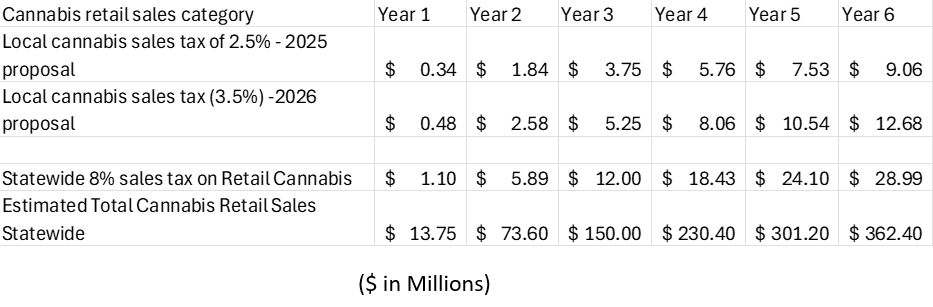
So, while it is unlikely there will be any local windfalls from cannabis retail sales, it is not yet clear if the local cannabis retail sales tax rate will be in addition to local sales and use taxes.
VML will continue to monitor and advocate on behalf of cities, towns and counties as this legislation progresses through the 2026 General Assembly session.
VML Contact: Mitchell Smiley, msmiley@vml.org
Health & Human Services
Commission on Youth approves study recommendations for legislative action in 2026
Increasing opportunities for diversion, clarifying length of stay, minimizing room confinement, and creating a workgroup to study the expansion of oversight by the Office of the Children’s Ombudsman to investigate complaints involving youth committed to the Department of Juvenile Justice were among the recommendations from a study of Juvenile Justice approved by the Commission on Youth at its December 2 meeting in Richmond.
The study focused on the state’s Bon Air juvenile facility but some of the recommendations, including involvement by the Office of the Children’s Ombudsman and room confinement guidelines, could affect local and regional juvenile facilities as well.
Both of those recommendations would involve creation of workgroups to further examine the issues and options to address the issues.
The Commission also received a briefing from Eric Reynolds, the director of the Office of the Children’s Ombudsman. This office receives and investigates complaints involving state and local social services, child placing agencies, and children’s residential facilities. He presented information about the number of complaints lodged with, screened by, and investigated by his office in the past year. The full report can be viewed on the Legislative Information System website.
Reynolds noted that there appeared to be critical gaps in the way some local social services departments handle children’s issues, including abuse and neglect complaints. He said that common practice issues identified in case reviews were related to:
- Local department participation in local child protection multidisciplinary teams.
- Follow-up with mandated reporters (e.g, teachers, doctors).
- Case transfers between local departments.
- Permanency placement decisions for abused and neglected children.
- Engagement with fathers.
He suggested that the state take a more active role in oversight of child protective services, including a centralized intake system and implementing corrective plans for noncompliance. He also recommended increased compensation for local workers, establishing equal pay scales across localities, and providing more in-person training and peer support to address turnover and compliance.
Reynolds also recommended making improvements in “plans of safe care” when parents have drug or alcohol abuse problems, including early intervention before a child is born to prevent issues from arising once a child is born. He said this issue is the one his office hears the most about each year.
Finally, he suggested creation in statue of a children’s cabinet. Some governors (but not the current governor) have convened a children’s cabinet by executive order but it is not in the Code of Virginia.
VML Contact: Janet Areson, jareson@vml.org
Behavioral Health Commission approves legislative and study recommendations for 2026
The General Assembly’s Behavioral Health Commission wrapped up its work on legislative recommendations and studies to be undertaken in 2026 during a meeting on December 2.
The Commission finalized its recommended legislative proposals for 2026. The Commission’s legislative package can be seen here >.
An issue of great interest to local governments concerns a study recommendation regarding the local government match for community services board/behavioral health authority services which was previously covered in eNews (November 14, 2025).
The Commission decided at its December 2 meeting to pursue a budget amendment in the 2026 General Assembly session to direct the Department of Behavioral Health and Developmental Services to examine alternatives to the current 10 percent local match requirement and report its findings and recommendations to the Behavioral Health Commission by Nov. 1, 2026. It requests recommendations for:
- a formula for calculating the required annual local match amount, which accounts for regional funds; the timing mismatch between state and local budgeting; and the variation in localities’ fiscal situations;
- a standardized formula for dividing contributions between localities within a multijurisdictional Community Service Board;
- enforcement mechanisms to be used by DBHDS or other state entities when the required match is not met by a locality; and
- an estimate of the budget impact of any recommendations on the state and local governments.
The Commission also finalized its studies for 2026. New studies for the Commission in 2026 include availability and effectiveness of substance use disorder programs in Virginia schools; efficiency of the restoration of competency process, and the use and effectiveness of mandatory/assisted outpatient treatment.
Also new for 2026 (but beginning this month) is an examination of behavioral health services in local and regional jails. That study will include:
- an environmental scan of behavioral health services, treatment, and practices available versus those needed in jails;
- possible updates to baseline standards for behavioral health treatment;
- examination of barriers to (i) providing services and treatment to inmates with serious mental illness and (ii) meeting baseline standards of care; and
- options and recommendations for addressing those barriers to the treatment, including funding necessary to achieve baseline standards of treatment in jails.
VML Contact: Janet Areson, jareson@vml.org
Housing
Housing Commission meets; endorses concepts for legislation
On Thursday, December 4, the full Virginia Housing Commission met to endorse future legislation, receive a report on the eviction rates in Virginia, and hear an update on the hiring process for the Housing Commission Executive Director position.
Throughout the summer and fall, the Housing Commission subcommittees were busy exploring issues that could become legislation. At its full meeting, the Housing Commission endorsed two of the four concepts explored by the subcommittees.
The endorsed concepts were “Disclosure Requirements; Declarant Control,” which is disclosure of documents stating whether a community is under developer control, and “Annual Notice of Potential Assumption Required,” which requires notice of when a mortgage is assumable.
Additional concepts considered but not endorsed were “Home Inspectors Insurance Requirements and Prohibited Contract Provisions” and “Notice of Change in Assessment Resource Protection Area Disclosure.”
However, the commission announced that some concepts not endorsed by the housing commission could become legislation.
Also at the full meeting, commission staff provided an update on eviction rates following the eviction pilot program that was launched in 2023. Overall, eviction rates have gone up due to a series of factors.
When available the full presentation and legislative reports from the full meeting will be posted here >.
VML Contact: Josette Bulova, jbulova@vml.org
Opportunities
The National Civic League seeks applicants from Virginia for 2026 All-America City Award!
The National Civic League (NCL) is now accepting applications for the 2026 All-America City Award! The theme for 2026 is “America at 250: Strengthening Civic Health and Building Trust.” NCL is seeking communities that are bringing our founding ideals to life by ensuring that people have the power and opportunity to shape their collective future.
VML Executive Director Michelle Gowdy, who was recently appointed to the NCL board, encourages all VML member localities to apply to join the 21 communities from Virginia that have previously won the All-America City Award!
You can view the full list of past recipients here.
Communities interested in applying for the 2026 All-America City Award should submit a letter of intent to apply by January 5th, which saves applicants $100 on the application fee. Please note that a letter of intent is not required to apply.
The full application can be downloaded at (https://www.nationalcivicleague.org/america-city-award/how-to-apply/) and is due February 26, 2026. Twenty finalists will be named in March of 2026 and will be invited to attend the All-America City Award event in Denver, CO in June, during which the ten eventual winners will be selected and announced.
2025 Theme and Criteria:
As the nation marks 250 years since its founding, we reflect on the ongoing journey to fulfill the promise of a government by, for, and of the people. The 2026 All-America City Award will spotlight communities across the country that are creatively engaging residents in collective efforts to create thriving and welcoming places where trust and belonging are abundant.
Across the country, Americans of all backgrounds and political perspectives are expressing growing frustration with a system that feels unresponsive, untrustworthy, and ineffective. Civic trust is declining, polarization is deepening, and many people feel disconnected from the decisions that shape their lives. Fortunately, democracy has never been static, it is a living system that can be renewed and reshaped through collective effort.
The 2026 award will honor communities that are reinventing how they come together to make decisions and solve problems. These communities engage residents, businesses, and public institutions in civic dialogue, collaboration, and community-building efforts that not only strengthen civic life and rebuild trust but also address pressing challenges and lay the foundation for a better future. By advancing innovative, community-driven approaches to governance, they are helping shape a more responsive, resilient democracy for the next 250 years.
About the Award:
Since 1949, the National Civic League has designated towns, boroughs, cities, counties, and regions as All-America Cities for their outstanding civic accomplishments. The award was described by George H. Gallup as the “Nobel Prize for constructive citizenship,” the award celebrates exemplary grassroots community problem-solving and honors communities that have united to achieve stunning results.
The award spurs communities to use innovative approaches to create stronger connections among residents, nonprofits, academic institutions, businesses, and government leaders. The AAC Award celebrates those efforts and becomes a platform for sharing innovation, inspiration, and insight with other communities throughout the country.
“The All-America City Award brings community stakeholders together to showcase and be recognized for the programs and projects that address resident-identified challenges,” said Rebecca Trout, Director of the All-America City Award. “Year after year, applicants tell us the process strengthens their pride in their community and energizes them to take on persistent challenges. The League is honored to elevate these innovative efforts on a national stage, helping communities learn from one another and scale promising practices across the country.”
About the League:
The mission of the National Civic League is to advance inclusive civic engagement and promote innovations in democracy to make decision-making more participatory, equitable, and effective.
Founded in 1894 by a group led by Teddy Roosevelt and Louis Brandeis, the League is America’s oldest good governance organization. The League championed many of the democracy innovations of the early 20th Century; today, the League maintains the Model City Charter, organizes the All-America City Award, publishes the National Civic Review, and supports an extensive national network of local elected, appointed, and civic leaders. The League’s Center for Democracy Innovation works with public officials in the U.S. to understand, test, and disseminate the next generation of civic innovations, which have the potential to make democracy more participatory, equitable, and productive.
For 77 years, the National Civic League’s All-America City Award has uncovered, celebrated, and disseminated the finest examples of American civic innovation by inviting communities across the country to apply for recognition based on the strength of their civic capital – the formal and informal relationships, networks and capacities that enable communities to solve problems and thrive. Each year over 500 people from 20 finalist communities share how their communities are working together to tackle challenges and create real change.
National Civic League Contact: Rebecca Trout, rebeccat@ncl.org
Webinar: “Funding Resilience Projects in Virginia” happening December 10
VIRGINIAforever, a nonprofit dedicated to advocating for adequate and sustainable funding for the Commonwealth's natural resource programs, will be hosting a webinar on December 10 focused on funding resilience projects. This session will offer valuable insights including real-world case studies using state resilience funds from both Newport News and Roanoke.
A PDF with more details is available here >.
Registration is available here >.
After registering, a confirmation email will be sent containing information about joining the webinar. A recording of the event will be posted after it concludes.
VIRGINIAforever Contact: Karri B. Atwood, katwood@virginiaforever.org