eNews – August 14, 2026
One percent for school construction referendum survey, TAX to look mandatory property tax exemptions, Summer work group updates...and more!
Friday, August 14, 2026/Categories: eNews
This edition of eNews is sponsored by Virginia Housing, investing in the power of home to help Virginia communities thrive....Learn more >
In this issue:
Annual Conference
Education
Finance
Public Safety
Natural Resources
Elections
Technology
VML News
VML News Board - Recent Posts
Annual Conference
Updates and highlights…with more to come!
It’s less than two months until the VML Annual Conference at the Norfolk Waterside Marriott! In the coming weeks we will be sharing a detailed agenda, but for those already registered, or considering registration, we have some preliminary highlights and details to help you get ready.
Sunday, Oct. 11 – For those who prefer to arrive the day of the event, the conference kicks off at 2:00pm so you have plenty of time to get there. Even better – there are still plenty of rooms at the Norfolk Waterside Marriott available at the VML group rate for Sunday and Monday night. Reserve rooms here > (cutoff is Sept. 25 or when they sell out).
Monday, Oct. 12 – We are pleased to announce that this year’s Guest/Spouse ticketed offering will be an onsite Body Oil Candle Workshop led by local artisan Sunkissed by Kel. During the afternoon attendees will enjoy libations and snacks while they create their own 8 oz Body Oil Candle to take home. Note – Space is limited and we will not be able to accept registrations on-site. If you’ve already registered for the conference and would like to add this to your registration please contact Manuel Timbreza, mtimbreza@vml.org.
Also on Monday – beginning at 6:00pm, the City of Norfolk will host a reception at the nearby Selden Market and Slover Library event space. The shops will be open, there will be drinks, food, and entertainment…and it’s all happening a short walk from the Marriott!
Tuesday, Oct. 13 – As previously reported, the final morning of the conference will feature back-to-back general sessions on two crucial topics for Virginia’s local governments: Collective Bargaining and Retail Cannabis. For the latter topic, we are thrilled to announce that Adam Ebbin, Senior Advisor for the Virginia Cannabis Control Authority, will be presenting and answering questions. Please make plans to stay for this important closing session.
A preliminary agenda and registration for the Conference are available on VML’s website here >.
VML Contact: Rob Bullington, rbullington@vml.org
Education
Please let VML know if your locality will be holding a referendum for a 1 percent sales tax for school construction this year
As passed, the state budget includes statewide authority for all cities and counties to impose a sales and use tax of up to one percent dedicated solely to new school construction and modernization (and transportation for localities in PD8) if approved by voter referendum. This initiative has been a top priority for VML since 2020.
The deadline for receiving approval from the courts to hold the referendum for the November 2026 election is today (August 14). If your locality has received approval and will be holding the referendum this year, please let us know by completing this short survey >.
VML Contact: Josette Bulova, jbulova@vml.org
Finance
Department of Taxation to explore the effects of mandatory property tax exemptions
In the next few weeks, the Department of Taxation (TAX) will convene a work group to examine the cost to localities of mandatory property tax exemptions for disabled veterans and their spouses. As evidenced by the chart below, the costs continue to rise unabated, forcing local governments to make difficult decisions about their community’s funding priorities.
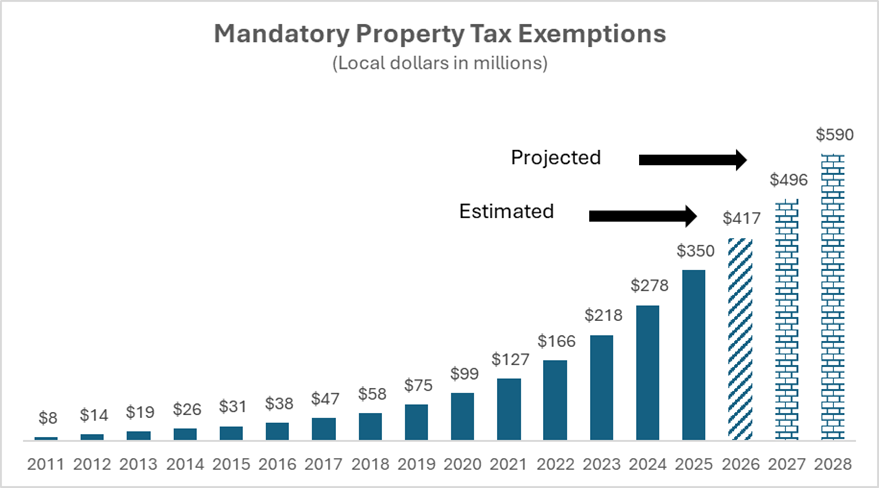
The work group was created at the request of VML and VACo who have continued to remind state lawmakers about the burden the rising cost of these unfunded mandates is placing on localities across the Commonwealth.
Localities reminded us of those pressures as they approved their FY 2027 budget. For example:
- Hampton told us that “While the City is proud to support those who have served our country, the cost of this State-mandated program has grown significantly in recent years and is now projected to cost $13.7 million in FY2027 or the equivalent of more than 8-cents on the real estate tax rate.”
- Virginia Beach explained “Program participation in the Veterans Real Estate Tax Relief Program has risen by 6,636 individuals since 2015. Total relief provided by this program is estimated to be $46.0 million in FY 2026-27, equal to 5.4 cents of the Real Estate tax. When compared to FY 2025-26, this represents an annual increase of $10.6 million or 30 percent.”
When the work group convenes in mid-September, it will be required to:
- Review and collect data on the cost of the exemption and implications to localities.
- Detail changes to the exemption and the impact of those changes to localities.
- Evaluate legislation previously introduced by the General Assembly on these exemptions.
- Provide any recommendations to the General Assembly on these mandatory property tax exemptions.
The report, with any findings and recommendations, is due to the Chairs of House Finance, House Appropriations, and Senate Finance and Appropriations Committees no later than November 15, 2026.
Since the implementation of these property tax exemptions, the Commissioners of the Revenue have been collecting data to itemize the cost of the unfunded mandates by locality. Based on the data set, which has been analyzed and adjusted to account for incomplete reporting in some localities, year over year growth in the 15 years of the program’s existence has exceeded 30 percent annually. In the past five years, growth has fallen slightly to 26 percent each year.
Senator Richard H. Stuart recognized the rising cost of these exemptions back in 2022. That year, he introduced SB360 that “would require the Commonwealth to subsidize local real estate tax relief for disabled veterans and their surviving spouses and surviving spouses of members of the United States Armed Forces killed in action when more than one percent of a locality's real estate tax base is lost due to such tax relief programs.” At the time, 19 localities reported exceeding the 1% threshold; today that number is 64.
In fact, in 2026, the cost of these exemptions exceeded 5 percent in five localities (see table below). Further, the percent growth from 2025 to 2026 in King George County is an eye-popping 48.3 percent.
|
Locality
|
Cost
|
Percent of Real Estate Revenues
|
Percent Growth from Prior Year
|
|
Stafford County
|
$32.4 million
|
10.1%
|
24.4%
|
|
City of Chesapeake
|
$31.2 million
|
7.3%
|
17.4%
|
|
Prince George County
|
$2.4 million
|
7.2%
|
16.4%
|
|
City of Poquoson
|
$1.8 million
|
7.0%
|
29.5%
|
|
King George County
|
$1.9 million
|
6.3%
|
48.3%
|
As extraordinary as the reported annual growth is in King George County, six localities experienced growth from 2025 to 2026 of more than 50% including those noted below. It is noteworthy that all the localities highlighted below are in rural communities. In other words, these mandatory exemptions aren’t just hitting local budgets in Hampton Roads or Northern Virginia but all areas of the Commonwealth.
|
Locality
|
2026 Cost
|
Percent Growth from Prior Year
|
|
Smyth County
|
$442,397
|
189.7%
|
|
Amherst County
|
$280,962
|
100.8%
|
|
Frederick County
|
$2, 018,277
|
88.2%
|
|
Buckingham County
|
$195,734
|
78.5%
|
|
City of Emporia
|
$48,481
|
57.1%
|
|
Wise County
|
$252,231
|
50.9%
|
Before the work group commences its deliberations, it is important that every locality transmit relevant data on their mandatory property tax exemptions to Mitch Nuckles (see contact information below) who collects this data on behalf of the commissioners.
Mitchell Nuckles, Commissioner of the Revenue
PO Box 858, Lynchburg VA 24505-0858
Mitchell.nuckles@lynchburgva.gov
434-444-1594 (cell)
434-455-3871 (phone)
434-847-1842 (fax)
https://www.lynchburgva.gov/commissioner-revenue
Staff at the TAX department are also considering soliciting data from localities to fill in some of the data gaps. VML will communicate any updates about this as needed.
It is hoped that the work group will rigorously review the program to understand why it is growing exponentially, and determine what, if anything, the Commonwealth can do to help.
VML Contact: Joe Flores, jflores@vml.org
State leaders should be reminded how local governments pay for essential services
Readers may remember that last year at this time, localities were watching nervously as candidates for governor railed against the car tax, vowing to reduce or eliminate this important local revenue source. One of the campaigns reached out to discuss the consequences for local governments if the car tax went away, while the other candidate did not.
Simply put, the local impact of eliminating the car tax would be consequential.
As members of the General Assembly gear up for election season next November, local leaders need to be prepared to explain how we generate our revenues at the local level and how we allocate our constituents’ resources.
Why? Well currently some state lawmakers around the country are discussing initiatives designed to put limits on – or drastically reduce how – local governments generate revenue. Accordingly, we think it is a great time to remind folks at the state level how cities, counties, and towns generate dollars at the local level. Spoiler alert, localities don’t ask their constituents to pony up resources willy-nilly; those requests are designed to fund core government services like K-12 education, public safety, health and human services, and infrastructure. But often, as noted in the property tax exemptions item in this newsletter, we need to generate monies to pay for promises the state makes, at the expense of local dollars.
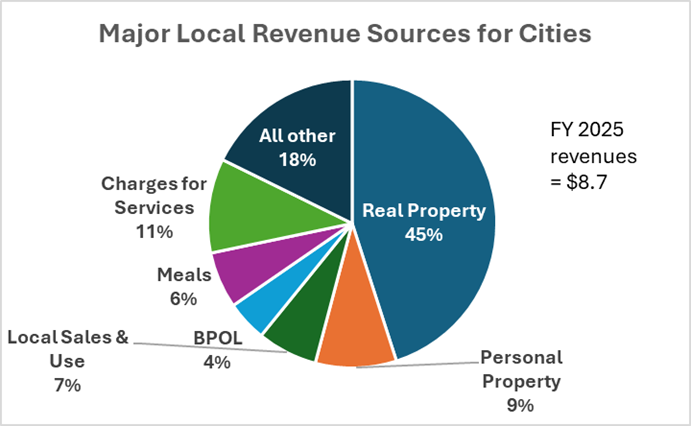
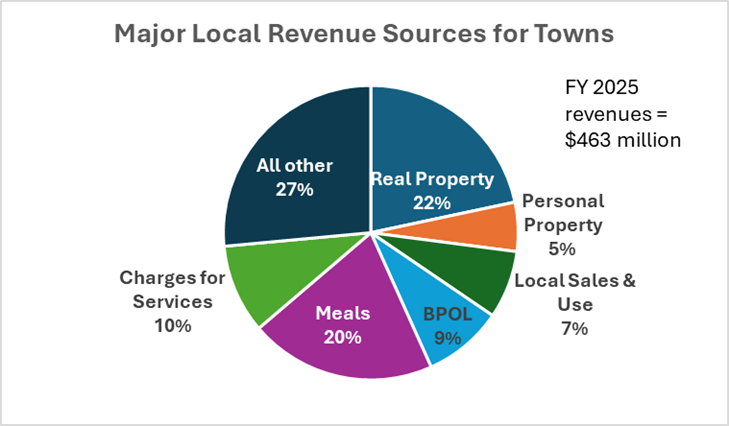
As seen below, major local revenue sources for cities and counties tend to mirror each other. Real estate and personal property account for most local revenues in cities (54 percent) and counties (67 percent) with lesser amounts from local sales and use and BPOL taxes.
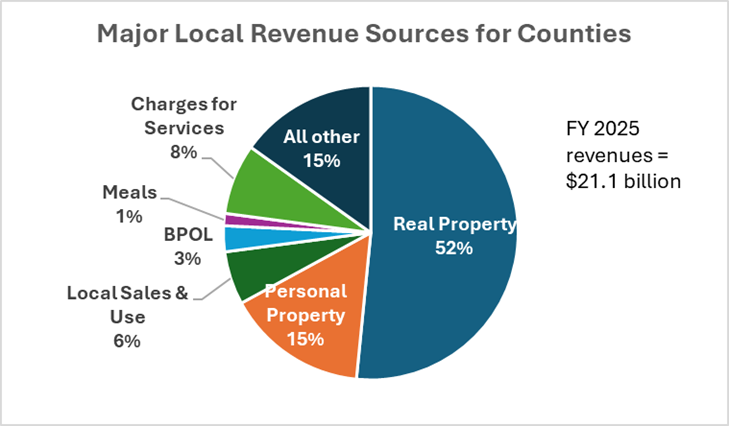
Towns, on the other hand, are less reliant upon property taxes that account for 22 percent of their revenues. Meals taxes account for 20 percent of local revenues; a much larger share of the revenue pie compared to cities (6 percent) and counties (1 percent).
How are those local revenues spent? Again, there are parallels between cities and counties. Most funding received by localities, including revenues from the state and federal governments, goes toward K-12 education that accounts for 45 percent of city spending and 57 percent of county spending. Only 4 percent of town spending goes toward education.
Public safety accounts for the second largest category of spending among cities (19 percent) and counties (16 percent) as well as towns (28 percent). Finally, spending on health and human services makes up roughly 11 percent of local expenditures in cities and counties but less than 1 percent in towns.
Without required spending on K-12 education in towns, most of their local revenues go toward public works projects and general government, in addition to public safety as previously mentioned.
VML Contact: Joe Flores, jflores@vml.org
Public Safety
Statewide Interoperability Executive Committee (SIEC) meets
The SIEC met on July 22 and was fortunate to have Senator Danny Diggs and Deputy Secretary of Public Safety and Homeland Security Dillon Taylor in attendance. There was a lot of discussion about the Emerging Technology Conference that will be held early next year so stay tuned! They also presented a resolution to Dana G. Schrad who is retiring from the Virginia Association of Chiefs of Police and Foundation (VACP). She was on the SIEC the entire 30 years that she was with VACP and will be sorely missed.
The group then took up SB525 entitled “Mutual aid agreements; public safety radio equipment;” which died during the 2026 General Assembly Session with a letter to the SIEC asking them to consider whether localities should have to provide information to program public radio safety equipment to other agencies/localities that they have entered into mutual aid agreements with. There was substantial discussion about cybersecurity, the age of the various public safety radio systems, and other technological issues that could arise. The Statewide Interoperability Coordinator will draft a report for the committee’s review.
This group will meet again in October to review the recommendations/report.
VML Contact: Michelle Gowdy, mgowdy@vml.org
Natural Resources
Water Quality Improvement Fund Work Group meets
The Water Quality Improvement Fund (WQIF) Work Group met earlier this week. The agenda included discussion of potential changes to the WQIF Reserve Fund as well as adoption of draft recommendations for the work group’s final report.
Regarding the WQIF Reserve Rund, the conversation centered around whether the reserve fund should be added to the code or remain solely within the budget. The work group determined the reserve fund is functioning as intended and saw no need to recommend legislation to codify it in state code.
The work group also discussed, amended, and approved multiple draft recommendations for the final report. Most impactful for localities, the work group approved a recommendation for the Stormwater Local Assistance Fund (SLAF) to remain separate from WQIF.
The work group will meet for its final meeting on September 16, during which the group plans to finalize all recommendations.
VML Contact: Jessica Dennis, jdennis@vml.org
Elections
Subcommittee recommends not aligning Virginia’s elections with Federal schedule
On August 3, the Joint Subcommittee to Study the Consolidation and Scheduling of General Elections met for the final time. This meeting completed its two-year long study process. Over the course of the study, the Subcommittee looked at the feasibility and willingness of stakeholders to consolidate all state and local elections to only even years. The change would align Virginia with the Federal schedule and move elections to every two years instead of the current annual schedule. To complete this transition, major changes would have to be made to every locality’s charter, the Code of Virginia, and the Virginia Constitution.
The first summer that the Subcommittee met (2025) was focused on gathering information from the Commissioner of Elections, Subcommittee staff, local general registrars, and local government officials on background, feasibility, and concerns. The three meetings held this summer included discussions on what legislation would look like as well as Subcommittee members’ preferences on specific implementation items like mandating localities, whether most changes should be made in the Code or the Constitution, and discussions surrounding the timeline.
After two years, the Subcommittee voted to NOT recommend moving forward with consolidation. This tabled the discussion.
VML Contact: Josette Bulova, jbulova@vml.org
Work group examines implications of same-day voter registration
On August 12, the work group to study same-day voter registration met for the second time. The work group was created pursuant to SB582/HB774 to study potential changes to the same-day registration (SDR) and provisional vote process. At its August 12 meeting, the work group heard from the National Conference of State Legislators (NCSL) on what other states are doing followed by an in-depth conversation from work group members on technological advancements and other processes that could be used to make the SDR process easier for administrators and voters. Localities with universities were identified as a pain point for the SDR process.
The next meeting of the work group will be held on September 9 when members will begin to develop policy recommendations to help address the issues raised during the August meeting.
VML Contact: Josette Bulova, jbulova@vml.org
Technology
JCOTS discusses transition to .gov domain for local governments; makes recommendations
The Joint Commission on Technology and Science (JCOTS) met on August 5 for presentations that included a brief on AI Chatbots specifically focused on companionship for minors, a study on age assurance and accountability within app stores, an overview of the findings and recommendations from the work group studying HB707 (the mandatory use of a .gov domain by some entities including local governments), and a presentation from Everra Health on Clinical AI.
Among the items on the agenda, VML was most interested in the final report from the work group studying HB707. VML, along with some of our local government members, was fortunate to be a member of that work group which first met on June 23. At that meeting the work group discussed the costs of implementation, eligibility under CISA guidelines, concerns over IT capabilities, concerns over staff knowledge and ability to manage the shift, and whether having a .gov domain prevents phishing schemes to the extent claimed. The final meeting of the work group was held on July 14, following an initial brief created by JCOTS staff. The final meeting focused on reports and questions generated by the brief as well as discussion on whether VITA was the appropriate entity for enforcement. Additionally, the Library of Virginia volunteered to create a program on cybersecurity.
JCOTS approved the following recommendations:
- Reintroduce HB707 in its final form (this includes a three-year delayed enactment).
- Modify original language to state that the required transition only applies to entities eligible for a .gov domain under the CISA definition.
- K-12 public schools are not eligible under this definition.
- Additionally, if an entity is eligible for a .gov AND a .museum or .edu the establishment may choose.
- Exempt VCU and UVA Health from the bill.
- Introduce a budget amendment to help small localities with the cost of adoption and transition.
- Note: there is not currently a definition of “small locality”, JCOTS staff will be creating a definition between now and November.
- Require entities eligible under the new provisions of the bill to list third-party vendors that may communicate directly with the public on behalf of a .gov eligible entity.
- Add language stating that any entity that fails to comply must submit an annual report to the General Assembly detailing what domains are out of compliance and the estimated cost to comply.
- Lastly, JCOTS staff will be researching who should be the agency enforcing compliance.
The VML General Laws Policy Committee has adopted language on this topic which requests funding for all localities that would be affected by the mandated transition to .gov.
The full report is available here >.
VML Contact: Josette Bulova, jbulova@vml.org
VML News
Nominating Committee members posted
Thanks to the individuals who will serve on VML's 2026 Nominating Committee. The members have been posted to VML's website here >.
VML Contact: Michelle Gowdy, mgowdy@vml.org
 VML News Board – Recent Posts
Please check the VML News Board (no password required) for the latest notices and opportunities for local governments, including recently added items such as: