eNews – April 24, 2026
Legislation updates, VML General Assembly webinars next week, Small Towns Conference registration closes May 1....and more!
Friday, April 24, 2026/Categories: eNews

This edition of eNews is sponsored by HomeServe with unexpected home system breakdowns costing big in out-of-pocket expenses, having a plan from HomeServe in place is a smart choice..Learn more >
In this issue:
VML News
Finance
Collective Bargaining
Cannabis
Housing
Elections
Transportation
Skill Games
Public Safety
Opportunities
VML News
 Small Towns Conference registration closes May 1
Officials and staff from towns of all sizes will benefit from this event with topics related to local government management specifically geared to town issues.
The preliminary agenda is now available on the event page here >.
Registration includes the pre-conference afternoon workshop on May 13, a full day of conference programming on May 14, and a morning of back-to-back sessions on May 15. Plus, there will be networking receptions on the evenings of May 13 and May 14.
If you haven't signed up yet, please don't wait too long. The last day to register is Friday, May 1.
All the details as well as the link to register are available here >.
See you in Chincoteague!
VML Contact: Rob Bullington, rbullington@vml.org
VML General Assembly Session Review webinars next week: April 27 and 28
The 2026 General Assembly Session is over, with a special session scheduled for April 23 to address the 2026-2028 budget.
VML invites officials and staff from our member localities to join us for a webinar to review the actions of the 2026 General Assembly most important to you.
The webinars are free, but registration is required.
Please use the links below to register for the appropriate Zoom session prior to the event.
Town Section: General Assembly Session Review Webinar
City & Urban Sections: General Assembly Session Review Webinar
We look forward to seeing you later this month!
VML Contact: Janet Areson, jareson@vml.org
Today’s deadline for ADA compliance remains despite DOJ extension
On April 24, 2024, the final ruling from the U.S. Department of Justice (DOJ) updating regulations for Title II of the Americans with Disabilities Act (ADA) was published in the Federal Register. This ruling addressed specific requirements to ensure web content and mobile applications are accessible to people with visual and physical disabilities.
The deadline for compliance was set for April 24, 2026, for localities with populations of more than 50,000, and April 26, 2027, for localities with populations less than 50,000 (according to census data). The 2025 General Assembly passed legislation codifying the DOJ ruling and deadline for compliance into Virginia Law.
Earlier this week, the DOJ extended its compliance deadline by one year. However, since the Virginia General Assembly codified the original DOJ requirements and dates, all Virginia localities must still comply with those original compliance deadlines of April 24, 2026, and April 26, 2027 (depending on population).
As a reminder, localities with a population of more than 50,000 must implement compliance measures by today, April 24, 2026; those with populations less than 50,000 must come into compliance by April 26, 2027.
VML Contact: Josette Buolva, jbulova@vml.org
VML's 2026 policy process is underway!
VML has five policy committees that meet once in July to learn about issues; review, revise, and propose VML policy positions; and recommend issues for consideration by VML's legislative committee. The draft policy statements are reviewed and voted on by the VML membership during the annual business meeting.
You can read more about VML’s policy committees on the policy page on VML’s website.
- Who's eligible to serve? VML full-member local governments may nominate their governing body members, appointed officials, and senior-level staff/department directors to serve on a committee. No more than two individuals from the same locality can serve on the same committee.
- How many committees can an individual join? One committee per person, please.
- How do committees meet? Committee meeting dates and times will be announced soon; all meetings will be held on Zoom.
- How can I sign up? Policy committee nominations forms were recently sent to VML-member managers and clerks. If you wish to be nominated, please submit your forms by May 15, 2026.
VML Contact: Janet Areson, jareson@vml.org
Finance
General fund revenues through March 2026 appear strong but weaknesses abound
A little more than a week ago, the Secretary of Finance Mark Sickles presented the monthly revenue report from March 2026 to the Senate Finance and Appropriations Committee.
On the bright side, revenues through March 2026 remain above the forecast by $709 million, 3.2 percent above projections. But the positive revenue numbers mask several concerning issues.
Most of the increase reported through March is related to lower-than-expected refunds from individual income taxes and higher non-withholding payments, two volatile sources of general fund revenue, especially the latter that is related to capital gains and estimated payments. The mainstay of the Commonwealth’s general fund revenues come from withholdings (i.e., wages and salaries) and sales and use taxes. The former came in relatively constant at 0.4 percent above the forecast while the latter was 1.9 percent above projections.
Secretary Sickles also pointed out that revenues from non-withholding are “a backwards looking metric”, based on strong stock market performance in 2025 and refunds can be attributed to taxpayer behavior, not necessarily the economic strength of the current economy. Since January, his message has been clear. While general fund revenues appear strong through March, we should not expect that trend to continue.
To be fair, there continue to be differing opinions about where the economy is headed. Nationally, many economists and business leaders suggest that the economy’s fundamentals, including business investment and consumer spending, are strong and are likely to benefit from the federal tax changes that were approved last July.
On the other hand, the economic outlook has only become cloudier since January. Oil and gas prices bounce around by the day, access to goods may become constrained this summer, and consumer confidence is abysmally low as inflation remains high and the job market is mired in a “no fire, low hire” employment pattern.
April and May are the most important months in the Commonwealth’s revenue calendar. We’ll pore over that data carefully when it becomes available to see what it may mean for the months ahead.
VML Contact: Joe Flores, jflores@vml.org
Budget agreement remains elusive
Earlier in the week there was chatter around Capitol Square that there might be movement on the budget. Yesterday, we heard that the bottom-line revenue figures from the House and Senate may be coming closer together, but any talk of a final budget deal sounds like wishful thinking.
Mid-week, Speaker of the House, Don Scott commented that a budget may not be finalized until June. Whether that’s June 1 or June 30 remains to be seen. Lead negotiators in the House and Senate seem to agree that we’re not close to being done.
Unchanged since late February, the roadblock revolves around the appropriate level of taxation from data centers. Filling the billion-dollar pothole that separates the House and Senate budgets would go a long way toward solving the differences in their spending plans. Late yesterday it was reported that there may be agreement to move toward the Senate’s revenue assumptions, resulting in $1.6 billion in new general fund monies, presumably from data centers. What form that takes remains a mystery. While Delegate Torian was quick to point out that there may be a way to bridge their revenue differences, no spending commitments had been made.
It is fair to say that when the 2026 Session was gaveled in during January, there was more chatter about what bills might pass the General Assembly and ultimately become law then whether a budget would be enacted on time.
Unfortunately, special sessions on the budget have become regular occurrences of late. In fact, the General Assembly has met in special session eight of the last ten years to resolve differences on the budget (see chart below). Another trend that has emerged since 2006 is that each year a new governor takes the reins of the Commonwealth, lawmakers tend to go into overtime on the budget. Since 2006, former Governor Bob McDonnell (2010) is the lone exception.
Arrow notes when a special session on the budget was required.
|
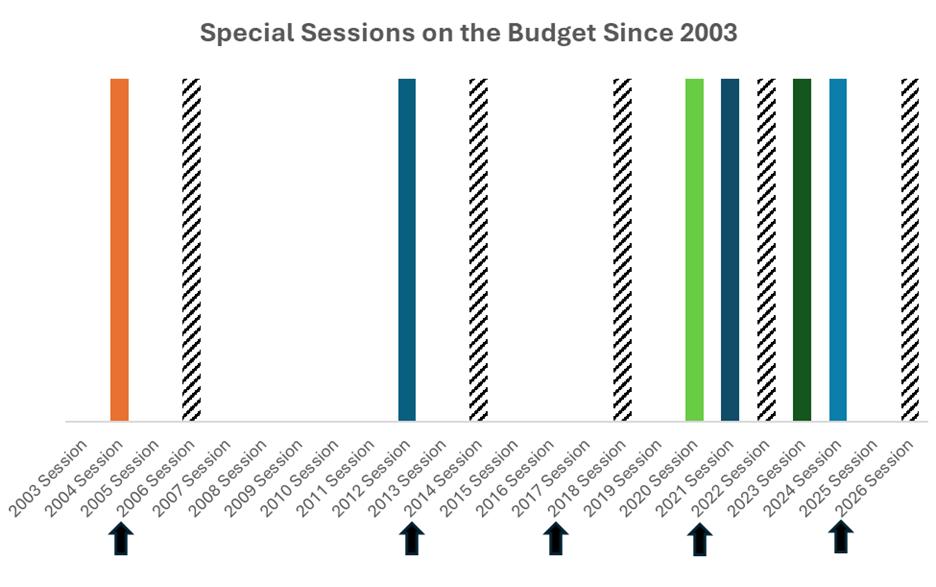
Even though many of us have become used to state budget-writers taking extra time to complete their fiscal assignments, it doesn’t mean that we like it nor does it make the job of local government officials any easier. Cities, counties, and towns need to finalize their own budgets and are unable to put a bow on their work until the Commonwealth’s budgeteers finish their responsibilities.
VML will remind state lawmakers why it’s important to localities that the budget be completed sooner rather than later. In the meantime, local officials should talk to their finance and budget directors to fully appreciate and understand the implications of a protracted delay and communicate those observations to VML, so we can relay that information to the Commonwealth’s budgeteers.
VML Contact: Joe Flores, jflores@vml.org
Collective Bargaining
General Assembly rejects Governor’s changes to collective bargaining bills
SB378 (Surovell) / HB1263 (Tran) Collective bargaining by public employees; Public Employee Relations Board established; exclusive bargaining representatives.
The House and Senate rejected out-of-hand the Governor’s substitutes for the two identical bills. The bills require public employers and employee organizations that are exclusive bargaining representatives to negotiate in good faith with respect to wages, hours, and other terms and conditions of employment. The bills create the Public Employee Relations Board (PERB), which will rule on appropriate bargaining units and provide for certification and decertification elections for exclusive bargaining representatives of state employees and local government employees.
Due to the significant steps that the bills require (i.e., setting up PERB, etc.), the law will become completely effective July, 1 2028. The bills provide that any existing collective bargaining agreements will remain in effect until at least that time.
Among other things, the Governor’s amendments which the General Assembly rejected had given localities until 2030 to deal with the issues created by the legislation.
Once the system is up and running and localities become subject to collective bargaining for their employees, these bills will cost local governments nearly a billion dollars annually. VML continues to oppose the legislation. This is a fundamental change in employer/employee relationships in Virginia’s local governments, as well as for the Commonwealth’s agencies.
VML Contact: Mark Flynn, markkflynn@gmail.com
Cannabis
General Assembly rejects Governor’s amendments to cannabis retail sales bills
SB542 (Aird) / HB642 (Krizek) Cannabis control; retail market; penalties.
The House and Senate rejected proposed amendments from the Governor that would have limited local input during the licensing of cannabis businesses. The Governor now has 30 days to act on the legislation as passed by the General Assembly. The options the Governor can take include signing the legislation, allowing it to go into effect without signature, or vetoing the legislation.
This legislation includes new local authority to levy taxes from 1-3% on retail sales, adopt ordinances regulating the hours cannabis retails may operate, establish a minimum distance between retailers and other uses less than 1,000 feet, establish penalties for public consumption of cannabis and cannabis consumption on school property. The legislation also includes requirements that must be considered by state regulators including compliance with local safety and health regulations as well as local notice provisions for proposed licensees with opportunities for the locality to provide feedback on specific licensing applicants and locations.
The legislation before the Governor provides more local input into the licensing process than the amendments proposed by the Governor that the General Assembly rejected. This legislation will include significant new local authority to tax and regulate cannabis retail businesses. If Virginia is going to establish legal recreational cannabis retail sales market the legislation before the Governor includes more authority for localities than any other piece of legislation that has been before a governor since the General Assembly began considering this issue in 2020.
VML Contact: Mitchell Smiley, msmiley@vml.org
Housing
General Assembly approves amended Faith in Housing bills; will become effective July 1, 2026
HB1279 (Cole) / SB388 (McPike) Affordable housing; religious organizations and other nonprofit tax-exempt properties.
The legislation originally would have allowed certain non-profit organizations and religious organizations to build by-right housing on their property with only administrative approval. These projects would also be deemed approved if the locality doesn’t act within 90 days. This precluded any opportunity for meaningful public input. Finally, only 60% of the units would have to be affordable. The bill expires on January 1, 2031.
The Governor’s amendments made minor changes, but the legislation is still an unfunded mandate which VML opposes. The bills create a new code section §15.2-2288.9 which sets out the statutory authority for the creation of housing on religious organizations and other tax-exempt properties.
The first substantive change removed local authority to make the housing tax exempt on these properties. The amendments next clarified the applicable code sections to be used in the review of these projects as well as the height requirements.
Added to the code section was also the fact that these projects will be found substantially in accord with the comprehensive plan and encourages applicants to seek the resources available at the Department of Housing and Community Development.
On April 22, the General Assembly approved the amended legislation and the Governor signed it into law with an effective date of July 1, 2026.
VML Contact: Michelle Gowdy, mgowdy@vml.org
Elections
Ranked choice voting option for all localities signed into law as amended by the Governor
HB630 (Callsen) / SB176 (VanValkenburg) Elections; conduct of election; ranked choice voting; locally elected offices; report.
This legislation expands the option to use ranked choice voting to any local governing body including town councils. Previously, the option was available only for county boards of supervisors and city councils. Additionally, these bills require the State Board of Elections to provide the standards and approval for vote tabulating software for use with existing voting systems in elections conducted via ranked choice voting. These bills also allow localities to request a risk limiting audit be conducted. Finally, these bills repeal the expiration for ranked choice voting placed on the initial bill in 2020 making ranked choice voting a permanent choice for localities.
The General Assembly accepted the Governor’s recommended amendments with an effective date of July 1, 2026.
Transportation
Amended parking minimums bill approved
HB888 (Shin) Minimum off-street parking requirements in certain areas.
The General Assembly has accepted the Governor’s amendments to HB888. The amendments had the effect of narrowing the impact of the bill to preserve existing local ordinance authority to establish parking minimums. The bill narrowed the legislation to limit the amount of parking a locality may require during a rezoning to ½ a space per unit in multifamily developments and 1 space per unit in single family, two family and townhouses. The bill also requires localities with a population greater than 20,000 adopt an ordinance to provide an administrative reduction of parking minimums and include criteria to determine eligibility and procedures for the review of administrative reduction of parking minimums. The bill requires a review process at the request of a developer to consider an administrative reduction of parking minimums for residential, multi-family or mixed-use development proposed of not less than 20% of off-street parking.
Since the General Assembly accepted the Governor’s amendments the bill now becomes law and will go into effect July 1, 2026.
VML Contact: Mitchell Smiley, msmiley@vml.org
Skill Games
Vetoed skill games legislation means no action this year
SB661 (Rouse) Regulation and taxation of electronic skill gaming devices; penalties.
The Governor’s veto of SB661 addressing regulation and taxation (i.e., legalization) of skill games was sustained when the Senate took no action on the bill during the reconvened session. Spanberger’s veto message on April 13 emphasized the fragmentation of current oversight over gaming and the need for a dedicated, independent entity to regulate all forms of gaming to ensure compliance, protect consumers, address impacts on communities, and prevent illicit activity.
The veto puts an additional hole in revenues anticipated by the state in the coming year, prevents collection of local tax revenue as authorized in the legislation, and continues the work on addressing the issue for another year.
VML Contact: Janet Areson, jareson@vml.org
Public Safety
Gun sell-back/give-back bill remains headed for enactment
HB702 (Cole) Virginia Firearm Give-Back Program and Fund established.
This bill requires all city and county law enforcement agencies to adopt a gun buy-back program, with exceptions for weapons that are evidence in a criminal prosecution. Each such law enforcement agency is required to hold one event annually. It permits towns to do the same. The Governor made technical changes, which were accepted by the General Assembly.
VML Contact: Mark Flynn, markkflynn@gmail.com
Opportunities
RELI spring webinars: Meet Governor Spanberger’s secretaries
George Mason University's Regional Elected Leaders Initiative (RELI) will host a virtual series with some of Governor Spanberger's secretaries.
Secretary of Finance Mark D. Sickles
Secretary of Health & Human Resources Marvin B. Figueroa
Secretary of Natural & Historic Resources David L. Bulova
RELI Contact: Mary Hynes, SchaRELI@gmu.edu
National Civic League survey to inform national initiative on cybersecurity for local governments
The National Civic League (NCL) is excited to launch CyberSim and Take9 for Civic Digital Resilience, a new national initiative in partnership with Craig Newmark Philanthropies and Aspen Digital at the Aspen Institute. Through immersive cybersecurity simulations, local governments and civic leaders will build the skills, partnerships, and awareness needed to protect critical community infrastructure.
As we begin this work, we’re launching a short baseline survey to help us tailor these interactive simulations to the challenges communities are facing. Take this quick survey to help us better understand:
- The digital security threats local governments are encountering
- Local government capacity to prevent and respond to cyber incidents
- The types and effectiveness of cybersecurity trainings being offered to local governments
- How individuals prefer to learn about digital security
Why Cybersecurity?
Cybersecurity may not immediately seem connected to the National Civic League’s civic engagement and democracy-strengthening mission, but digital security is foundational to public trust, reliable service delivery, and meaningful democratic participation.
Too often cybersecurity is framed as abstract, technical, and disconnected from day-to-day governance and public wellbeing. As a result, communities struggle to prioritize it, even as the risks grow. A national survey of local officials found that only 67% believe their cybersecurity funding is sufficient, even as 44% report experiencing cyberattacks on an hourly or daily basis. The National League of Cities estimates the average cost of a single breach at $6.53 million.
Beyond financial loss, the consequences of cyber(in)security include eroded public trust, disrupted services, and diminished civic participation. Imagine a resident who joins a participatory budgeting process or serves on a community survey panel, only to learn that their personal data has been stolen. How likely is that person to participate again, or to encourage others to do so? What about those whose access to public health services or basic utilities are disrupted at a critical moment? How likely are they to trust their government to meaningfully deliver for them?
Local governments and civic organizations are particularly vulnerable. They manage sensitive data and critical infrastructure, often with limited staff and budgets. With federal investment for state and local cybersecurity now facing more significant cuts, the burden of protection is shifting even more heavily onto local governments themselves. In a world of shrinking budgets and competing priorities, it is more essential than ever that local governments and communities understand why cybersecurity matters, so that they are motivated and empowered to prioritize it accordingly.
Why CyberSim?
CyberSim is an interactive, role-playing, tabletop exercise originally designed by The National Democratic Institute to help democratic actors, civil society members, and political parties abroad experience and practice defending against real-world digital security threats.
Over the next year, NCL and Take9 will adapt and deploy new editions of CyberSim specifically designed for local governments and civic organizations. These immersive simulations bring digital threats to life in realistic community scenarios, helping participants:
- Experience and respond to the cascading impacts of cyber incidents
- Clarify roles and responsibilities
- Strengthen cross-sector partnerships
- Identify practical steps to improve preparedness
Rather than relying solely on compliance checklists or technical training, CyberSim builds awareness through lived experience, creating the emotional connection and shared understanding necessary to prioritize cybersecurity.
Building Civic Digital Resilience Nationwide
In 2026, CyberSim will roll out in communities across the country. NCL will:
- Convene local governments and civic organizations for in-person simulations
- Use a train-the-trainer model to scale the program nationally
- Feature the simulations at events and conferences
- Leverage our extensive network to raise awareness and strengthen preparedness.
CyberSim will help communities identify scalable approaches to strengthening digital security, civic collaboration, and public trust. Cybersecurity is not separate from civic health. It is essential to it.
Take the survey and help us shape this next phase of civic digital resilience.
NCL Contact: Rebecca Trout, rebeccat@ncl.org