eNews Special Edition – July 1, 2026
Budget Review for Local Governments
Wednesday, July 1, 2026/Categories: eNews
Budget Review for Local Governments
As of June 29, 2026, the Commonwealth has a budget for the 2026-28 biennium! It was a long time coming, but it’s done, with one day to spare.
Just a week earlier, the Commonwealth’s legislative budget writers were able to wrap up their fiscal homework, admittedly a few months late. Wanting to have her say and final stamp on the budget, the Governor requested 14 amendments – seven language-only changes and five that recommended $63 million in additional funding – that were ultimately approved at the second Reconvened Session of the 2026 Session on Monday. Later that day, Governor Spanberger signed her name to the new biennial budget.
VML staff have highlighted some of the important fiscal policy issues we followed during the 2026 Session and others that have implications for local governments. Those items are included in this Special Edition of eNews. Look for an even more in-depth budget analysis in the July/August issue of VML’s magazine Virginia Town & City.
Use the links below to jump to individual topics:
Budget Overview
The final budget deal signed on Monday, June 29 was no doubt greased by $1.5 billion in additional general fund resources from a revised economic forecast issued in early June, $1.2 billion from a new Data Center Electricity Consumption tax, and more than $900 million from the rejection of most of former Governor Youngkin’s tax policy changes.
Data centers take center stage
The dispute about the appropriate level of taxation on data centers was clearly the fiscal policy issue that led to the protracted budget delay. Simply put, the Senate budget proposed to sunset the sales and use tax on data center equipment at the end of 2026, instead of 2035. While the exemption was initially projected to cost the general fund several million dollars each year, the tax incentive for data centers has grown to nearly $2.0 billion annually.
The House’s budget writers and Governor Spanberger acknowledged the foregone revenue but expressed concerns that sunsetting the exemption for a growing industry early could jeopardize the Commonwealth’s status as the data center capital of the world.
Ultimately, all parties agreed to a data center consumption tax that is expected to generate no more than $600 million each year with any excess being returned to the data centers, but it isn’t clear that this is the last word. In fact, the final budget directs a joint subcommittee to examine issues around the current tax exemption and other ancillary impacts of data centers as described below. Findings from that group may inform future policy changes.
Joint Subcommittee on Tax Policy Study on Data Centers (Item 1 #7c) – Requires the General Assembly’s Joint Subcommittee on Tax Policy to study the data center sales and use tax exemption and other data center impacts, including:
- reviewing Virginia's data center sales and use tax exemption;
- examining the impact of the existing and any potential future exemption or incentives;
- approaches taken in other states related to the data center industry including tax preferences, incentives, environmental standards and mitigation, moratoriums on incentives or location of new facilities, and sustainable development requirements;
- reviewing methods related to data center investment in non-urbanized areas of the Commonwealth;
- reviewing the recommendations and options in the 2024 JLARC study on Data Centers in Virginia;
- reviewing the estimated direct and indirect economic benefits of data center investment in Virginia;
- reviewing the direct or indirect impacts on the environment and quality of life related to data center location and siting;
- evaluating the impact of Artificial Intelligence on employment;
- reviewing the State Corporation Commission reported data on electric service agreements, water usage, permitted generators; and
- recommended mechanisms to provide direct revenue to the state from the data center industry.
A final report from the joint subcommittee is due to the General Assembly by December 15, 2026.
Two other data-center-related provisions address issues that come up during discussion about the industry are outlined below.
Data Center Cooling Water Scarcity Area Regulations (Item 366 #7c) – Authorizes the Department of Environmental Quality to establish criteria for determining Cooling Water Scarcity Areas related to data centers. DEQ is also required to conduct a study and provide a plan on the retrofitting of existing data centers in the Eastern Virginia Groundwater Management Area to use air cooling systems, 100 percent recycled water and/or stormwater for cooling, or use a closed loop system. That report is due by October 15, 2026.
Data Center Noise Regulations (Item 367 #2c) - Authorizes the Department of Environment Quality to adopt and enforce regulations for noise at data centers to be effective no later than December 31, 2029. The regulations are required to:
- be based on the Department's determination of the lowest achievable noise from a data center;
- establish the lowest achievable noise for a data center;
- provide that on or after January 1, 2030, any data center that violates such regulations shall be subject to a civil penalty of up to $32,500 per day of violation; and
- authorize and provide for enforcement by the Department or the locality in which the data center is located.
Budget winners
In total, the approved general fund operating budget sums to $73.6 billion for the 2026-28 biennium, including $8.3 billion in new general fund commitments. The approved budget also adds $2.7 billion in cash for capital projects.
The big budget winners of 2026 are not new to the limelight. More than $3.0 billion was allocated to health and human resources (HHR) programs, $1.9 billion to central appropriations, and $1.4 billion for elementary and secondary education. Those three categories accounted for more than three-quarters of new general fund spending in the 2026-28 biennial budget as depicted below – HHR (36%), central appropriations (23%), and K-12 education (17%).
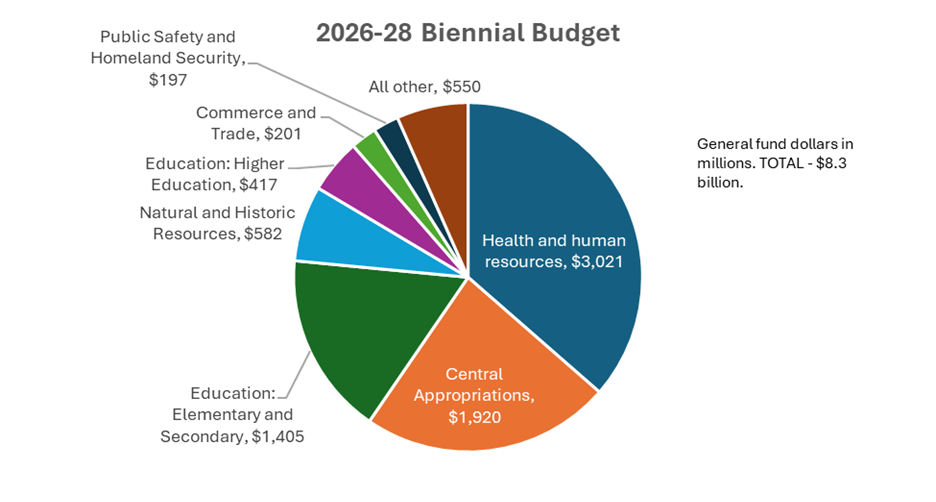
Most of the new general fund commitments in health and human resources are for required spending in Medicaid, primarily health and long-term care services for the elderly and disabled but also pregnant women and children. None of these new dollars are used for the Medicaid expansion population which receives no general fund support.
Central appropriations accounted for the second largest portion of new state spending in the final Conference Agreement. The introduced budget included 2.0% annual salary increases for state employees and state-supported local employees. The General Assembly upped the increase to 3.5% each year. In total, compensation costs for these salary increases totaled $714 million. The budget agreement also included several large infusions of cash including:
- $489 million for state agency health insurance premiums;
- $350 million for unanticipated increase in Medicaid spending;
- $225 million to address the uncertainty of federal funding; and
- $100 million for environmental impact monitoring.
Finally, elementary and secondary or K-12 education received large allocations of general funds to provide 4.0% salary increases in each year of the biennium. The cost of these increases is approximately $771 million. Funding for special education was augmented by $148 million in new allocations.
Last year, the House and Senate established interim work group to assess the impact of federal budget actions on the Commonwealth, meeting in various communities around the Old Dominion. The Conference Agreement includes roughly $624 million over the biennium to do so (see table below).
|
Response to Federal Budget and Policy Changes
(General fund dollars in millions)
|
|
|
FY 2027
|
FY 2028
|
Biennium
|
|
Federal Medicaid contingency fund
|
$225.0
|
-
|
$225.0
|
|
State premium assistance program
|
$150.0
|
-
|
$150.0
|
|
Fund the state share of SNAP
|
-
|
$135.0
|
$135.0
|
|
Replace federal SNAP administrative costs*
|
$43.0
|
$57.4
|
$100.4
|
|
Backfill reductions to the Ryan White HIV/AIDS program
|
$6.6
|
$6.6
|
$13.2
|
|
TOTAL
|
$424.6
|
$199.0
|
$623.6
|
|
*Included in Governor’s introduced budget
|
As a reminder, most of the federal budget decisions related to ongoing Medicaid funding have not been programmed into the state budget; the impact of those decisions will need to be addressed in the coming years.
VML Contact: Joe Flores, jflores@vml.org
Legislative – JLARC
JLARC: Review Aid to Localities (Item 25 #2c) – Directs the Joint Legislative Audit and Review Commission (JLARC) to include an analysis of state spending for aid to localities, at least every five years, as part of its State Spending report. VML staff will remind JLARC that the Commonwealth also requires numerous unfunded mandates that reduce the impact of state aid to localities.
JLARC: Review Teacher Compensation (Item 25 #3c) – Requires directs to periodically review comprehensive teacher compensation in Virginia, including benefits.
VML Contact: Joe Flores, jflores@vml.org
Finance – Property Tax Exemptions
Property Tax Exemptions Workgroup (Item 260 #1c) – Requires the Department of Taxation to convene a work group to review the cost of mandatory property tax exemptions for disabled veterans and their spouses. The workgroup is required to:
- review and collect data on the cost of the exemption and implications to localities;
- detail changes to the exemption and the impact of those changes to localities;
- evaluate legislation previously introduced by the General Assembly on these exemptions; and,
- provide any recommendations to the General Assembly on these mandatory property tax exemptions.
A report of the workgroup’s findings and recommendations are required to be submitted to the Chairs of House Finance, House Appropriations, and Senate Finance and Appropriations Committees by November 15, 2026.
VML Contact: Joe Flores, jflores@vml.org
Central Appropriations – State Supported Employees
State-Supported Locals Data Collection (Item 469 #2c) – This language only amendment directs the Department of Planning and Budget (DPB) to collect full-time salary data and employee counts of state-supported local employees each year. State-supported local employees are defined as:
- Locally-elected constitutional officers;
- General Registrars and members of local electoral boards;
- Full-time employees of locally-elected constitutional officers; and
- Full-time employees of:
- Community Services Boards,
- Centers for Independent Living,
- Secure detention centers supported by Juvenile Block Grants,
- Juvenile delinquency prevention and local court service units,
- Local social services boards,
- Local pretrial services act and Comprehensive Community Corrections Act employees, and
- Local health departments where a memorandum of understanding exists with the Virginia Department of Health.
The implementation of salary increases and bonuses for state-supported local employees has a tendence to be cumbersome and imprecise, creating confusion and morale issues at the local level. This language is designed to improve upon that process.
State Employee and State-Supported Locals Pay Raise (Item 469 #7c) – Includes $96.0 million in FY 2027 and $215.0 million in FY 2028 to provide 3.5% increase each year of the biennium for state employees and state-supported local employees. The local employee salary increase includes:
- Locally-elected constitutional officers;
- General Registrars and members of local electoral boards;
- Full-time employees of locally-elected constitutional officers; and,
- Full-time employees of Community Services Boards, Centers for Independent Living, secure detention centers supported by Juvenile Block Grants, juvenile delinquency prevention and local court service units, local social services boards, local pretrial services act and Comprehensive Community Corrections Act employees, and local health departments where a memorandum of understanding exists with the Virginia Department of Health.
VML Contact: Joe Flores, jflores@vml.org
Schools – One Percent Sales Tax for Construction
One percent local option sales tax for school construction (Item 4-14 #2c) – The final version of the budget included one of VML’s top priorities for the last several years: statewide authority for all counties and cities to impose a sales and use tax dedicated solely for school construction. Although nuances added to the language during the legislative process mean that the final product is not entirely what VML sought, this is still a big win for local governments.
All counties and cities are now authorized to impose a sales and use tax of up to one percent if approved by voter referendum and ordinance dedicated solely to capital projects or major renovations of public schools.
This authority is permissive; no locality is required to use this authority. To have this authority placed on the November 3, 2026 ballot, all actions necessary to hold a referendum must be completed 81 days prior to November 3 – if your local government attorney opines that early voting does not have to be included in the calculation. PLEASE contact your local government attorney IMMEDIATELY if you would like to use this authority in 2026.
Following the passage of the referendum, an ordinance must be approved, which in turn will become effective on the first day of the month, a minimum of 120 days after adoption. Please note, the timing of the referendum comes from the interpretation by the Commissioner of Elections and the Spanberger Administration.
Key components of this legislation mean that this tax:
- Can only be used for new capital projects or major renovations.
- Cannot be used for previous debts but can be used for future debts related to bonded projects.
- Expires 20 years after the date of the resolution.
- Is not granted as standalone referendum authority for the two towns which operate their own school divisions.
The budget also allows members of Planning District Eight (PD8) in Northern Virginia to use this authority for transportation funding related to the Washington Metropolitan Area Transit Authority (WMATA), as well as school construction. Any locality in PD8 wishing to use this authority for both transportation and school construction can do so, however the percentage must not exceed a total of one percent.
For questions related to the authority to impose a sales and use tax for school construction, please speak with your local attorney. VML can also serve as a resource for additional questions.
VML Contact: Josette Bulova, jbulova@vml.org
Cannabis – Retail Market
Cannabis retail marketplace established (Item 4-14 – Enactment 5) – Establishes a retail cannabis marketplace in Virginia with sales beginning July 1, 2027. Provisions include new local taxation on cannabis retail sales, continuation of local land use authority for cannabis retailers, expansion of local ordinance authority to prohibit the public consumption of cannabis or sharing of cannabis on public school property, and authorization for localities to adopt ordinances regulating the hours of operation for cannabis retailers. However, under the legislation localities will not be able to ban retail cannabis sales.
This legislation includes two authorities that have been VML priorities since 2021: local taxation authority on retail sales of cannabis and the continuation of local land use authority. A third priority – local authority to hold a referendum on retail cannabis sales – was not included in this legislation.
Localities are prohibited under the biennial budget from adopting any ordinances that prohibit the “cultivation, processing, possession, sale, distribution, handling, transportation, consumption, use, advertising or dispensing of marijuana or marijuana products”. However, a locality may adopt ordinances that:
- Regulate the hours of operation for marijuana retail to sell retail marijuana.
- Prohibit the public consumption or sharing of marijuana products as those acts are described in §4.1-1108.
- Prohibit the possession or consumption of marijuana products on the grounds of public elementary or secondary during or after school hours as those acts are described in §4.1-1109.
Localities are required to levy a local tax rate on cannabis retail sales of between 1-3.5%. Furthermore, localities retain land use authority over cannabis retailers and retailers must demonstrate during the application process for licensure from the Cannabis Control Authority that their premises are in accordance with local land use requirements
The language in the biennial budget establishes a maximum of 350 retail licenses with licenses to be distributed evenly among all areas of the Commonwealth (taking into account population densities) with retail stores limited to a maximum square footage of 2,500 square feet.
The Cannabis Control Authority must provide notice to localities through their manager, administrator or other designee with a 30-day window for the locality to provide any objections upon preliminary approval for a cannabis license. The Cannabis Control Authority may deny licensing if the applicant does not meet local land use and zoning laws and may revoke licenses if a business does not conform to local requirements regarding sanitation, health, construction, or equipment or if the business is delinquent by more than 90 days in payment of any local taxes, penalties or interest owed to the locality.
Under the budget language the Cannabis Control Authority will develop regulations for licenses ranging from cultivators and processors to retailers and other regulated activities during the second half of 2026 with licenses issued in early 2027.
VML Contact: Mitchell Smiley, msmiley@vml.org
Legislative Branch – Commission on Youth
Child advocacy center workgroup (Item 21#3c) – Directs the Commission on Youth to work with stakeholders (including VML) to develop recommendations to “incentivize” local governments to draw down additional funding to support Child Advocacy Centers through partnership agreements to include allocation of space, and administrative or other support. Recommendations will also include potential access to funding through various court fees or other revenue options. The report is due Nov. 1, 2026. Note: These centers currently receive state general fund support.
VML Contact: Janet Areson, jareson@vml.org
Judicial Branch – Indigent Defense Commission
Public defender support staff (Item 40#2c) – Provides $3.71 million and 45 positions each year of the biennium as additional support staff (e.g., paralegals, investigators, legal assistants) in public defender offices in line with 2023 JLARC recommendations.
VML Contact: Janet Areson, jareson@vml.org
Administration – Compensation Board
Redirect deputy sheriff funding (Item 60#2c) – Removes $3.90 million each year from the introduced budget that would increase the minimum number of deputy sheriffs in each office from five to 10.
Additional funds for assistant commonwealth attorney positions (Item 64#1c) – Restores state support for 50 assistant Commonwealth’s Attorneys and 15 support staff positions previously removed due to budget reductions.
Jail reporting requirements (Item 67#3c) – Authorizes the Compensation Board to withhold state reimbursements to local and regional jails for noncompliance with Board of Local and Regional Jail reporting requirements regarding deaths in custody. Funding will be released when reports are made in the same fiscal year that funds were withheld.
VML Contact: Janet Areson, jareson@vml.org
Commerce and Trade – Department of Housing and Community Development
Housing trust fund workgroup (Item 102#5c) – Directs the Department of Housing and Community Development to convene a workgroup to examine current uses of the Virginia Housing Trust Fund and provide recommendations on how to best optimize Fund resources to address housing affordability, supply issues, and homelessness. Provides an additional $40.0 million in the first year for deposit into the Fund, bringing total support to $215 million. Also provides $20 million in the first year for a two-year pilot program to provide loan origination and serving activities for mixed income housing.
Support homelessness services (Item 102#9c) – Adds $14.0 million in the first year for homelessness services; $7.0 million for rapid rehousing efforts and continuum of care lead agencies; the other $7.0 million is for the City of Charlottesville for development of transitional housing and training for individuals/families experiencing homelessness.
Restore local income energy efficiency program fund interest (Item 102#14c) – Removes language from the introduced budget that would divert funding from this program to the Department of Emergency Management.
VML Contact: Janet Areson, jareson@vml.org
Department of Education – Children’s Services Act
Education transition services guidance (Item 118#1c) – Directs the Department of Education to issue guidance on how localities can use authority to transition students back to public schools from private day placements and recommend how the Students with Intensive Support Needs funding and application process could be more flexible and useful for keeping students at risk of private placement in their public school setting.
Expand Support for students with intensive support needs application (SISNA) (Item 125#1c) - Provides $10.0 million the first year to serve additional special education students in public school settings by expanding the disability categories eligible for tuition reimbursement through the Department’s Student with Intensive Support Needs Application (SISNA) program, with a goal to reduce the number of students referred to CSA-funded private day school programs. Also updates the name of the program from Special Education Regional Tuition to SISNA and establishes annual reporting for this program. A companion amendment in the Office of Children’s Services establishes a similar report.
VML Contact: Janet Areson, jareson@vml.org
Health and Human Resources
Secretary’s Office
Coordinate work opportunities for Medicaid enrollees (Item 270#1c) – Requires the Secretary, along with the Secretary of Labor, to coordinate efforts with community providers to connect Medicaid expansion applicants/enrollees with work opportunities. Federal rules beginning Jan. 1, 2027, will require these enrollees to undergo eligibility redetermination every six months (currently 12 months) and be subject to work requirements.
Task force on SNAP error rates and community engagement (Item 270#2c) – Requires the Secretary of HHR to establish a task force to address the SNAP error rate and implementation of community engagement requirements in the Medicaid program.
Children’s Services Act
Private day special education program rate language (Item 271#1c) – Clarifies that the state’s cap on reimbursements to localities for private day special educational services applies to the per student/per diem tuition rate. The base rate is the maximum allowable amount for FY2026 and can increase 2.5 percent from the base amount year over year. Note: If a facility increases the per diem tuition rate above the 2.5 percent, local governments will be on the hook to pay the additional amount unless they can get the provider to comply.
Private special education placement reporting (Item 272#2c) – Requires the Office of Children’s Services to produce an annual report (due Dec. 1 each year) on CSA-funded private day special education placements to include total and per pupil local and state costs, number of students served, and local match rate amounts. Requires OCS to work with Department of Education to ensure data is comparable to and aligned with the annual report on Students with Intensive Supports Needs Application (SISNA) referenced in Item 125.
Department of Health
Opioid response strategic plan (Item 278#2c) – Provides funding to the Department each year of the biennium ($105,115) from the Commonwealth Opioid Abatement and Remediation Fund to develop a strategic plan for opioid response to reduce overdose and overdose death rates.
Fund core public health services (Item 278#3c) – Provides general fund ($14.94 m in FY27; $16.91 m in FY28) and non-general funds ($578,702 each year) to support and maintain core public health services, including epidemiological response capacity/preparedness, and public health systems including IT and cybersecurity. Also includes funding for medical facility inspectors and funding for eight community health services positions.
Backfill reductions to Ryan White HIV/AIDS program (Item 278#4c) – Provides $6.60 million each year to backfill anticipated loss of federal funds for this program. Will restore medical and supportive services and prevent disruptions in life-saving medications for Virginians living with HIV.
Fund free clinics (Item 282#2c) – Provides $5.0 million each year to support free clinics’ delivery of medical, dental, vision, speech, hearing, and behavioral health care services and prescription medications and substance use disorder treatment.
Drinking water grants (Item 283#1c) – Provides $50.0 million in the first year for the Virginia Department of Health to provide one-time grants to localities to upgrade or replace drinking water infrastructure. A local match of 25 percent is required. Original offers to Town of Bowling Green and Counties of Greene and Fauquier will be honored. For new grants, prior year applications will be considered, and priority consideration will be given to the Towns of Orange, Jarratt, and Blackstone and County of Fairfax. Funding will also be given to City of Richmond for capital improvements to its water treatment plan.
Medical Assistance Services
Behavioral health redesign (Item 291#9c) – Delays implementation until July 1, 2027.
Medicaid sustainability work group (Item 295#7c) – Directs DMAS to convene a work group to analyze Medicaid expenditure trends and identify strategies to moderate the rate of spending growth while preserving access to quality care in compliance with the law. Report is due Nov. 1, 2027.
Department of Behavioral Health and Developmental Services
Recovery residences oversight (Item 299#1c) – Provides funding and one position for DBHDS to adopt regulations for recovery residences and monitor credentialing agencies pursuant to the Code of Virginia (Chapter 1079 and 1000, 2026 Acts of Assembly).
Crisis facilities incentives for no-barrier model (Item 299#3c) – Directs DBHDS to identify strategies to serve more individuals subject to emergency custody/temporary detention orders in crisis facilities with incentives for such centers/units to adopt a no-barrier approach for all individuals and to offer rapid drop-off option for law enforcement.
Study of local match for CSBs (Item 299#4c) – Directs DBHDS to examine alternatives to the current local match requirement for community services board/ behavioral health commissions (CSBs & BHCs). The report is due Nov. 1, 2027.
Statewide implementation of Marcus Alert (Item 301#1c) – Adds $3.60 million in the first year and $7.80 million in the second year to support statewide implementation of this program that emphasizes a behavioral health or co-response, rather than solely public safety, response to behavioral health crises.
STEP-VA reporting (Item 301#5c) – Directs DBHDS to collect detailed annual expenditure and service data from CSBs/BHAs on STEP-VA services and to assess whether flexibility may be needed to reallocate funds among STEP services to match community needs.
Department for Aging and Rehabilitative Services
Community brain injury services (Item 318#1c) – Provides $750,000 each year for community services for individuals with brain injuries to address waiting lists for services and meet existing critical service needs.
Department of Social Services
Child welfare workforce support (Item 328#1c) – Provides $300,000 each year and one position for a statewide program to provide better support for the well-being of local social services workers and improve workforce retention.
Payment error rate vendor (Item 328#2c) – Provides $1.0 million GF/NGF each year for the Department to contract with a vendor to assist in efforts to decrease the SNAP error rate.
Employment supports (Item 328#3c) – Provides $1.5 million each year to help individuals receiving SNAP or Medicaid and subject to new federal work requirements to make connections to qualifying employment or volunteer activities and resources.
State share of SNAP benefit allotments (Item 329#1c) – Provides $135.0 million in the second year for potential use as a state match for a federal SNAP benefits cost share.
SNAP error rate data by locality (Item 330#2c) – Requires the Department to establish and maintain a quality control methodology for determining each local social services department’s payment error rate and publish those rates along with the state error rate by June 30 each year.
Funding expanded child abuse reporting requirements (Item 330#3c) – Provides $258,516 in the first year and $323,165 in the second year to address increased local workloads associated with legislation (HB 1414) that expands the number of mandatory reporters of child abuse and neglect and will likely increase reports made to local departments.
Local social services funding (Item 330#4c) – Requires the Department to report on allocation and use of state and federal funds distributed to local departments of social services, including the funding received and federal grant source; programs and services supported by the funding; and the amount of local funds required and contributed for applicable matching requirements. Report is due September 1 each year.
Centralized CPS intake system (Item 333#2c) – Provides $2.45 million in the second year to support initial implementation costs of creating a centralized child protective services intake system pursuant to Chapter 900, 2026 Acts of Assembly. Also provides $1.0 million each year to support a third-party contract to conduct a comprehensive review of local screening processes for CPS complaints.
Child advocacy centers (Item 335#1c) – Provides $1.5 million each year from TANF balances to increase funding for these centers.
VML Contact: Janet Areson, jareson@vml.org
Public Safety and Homeland Security
Department of Criminal Justice Services
Jail mental health pilot program (Item 394#1c) – Ends the model addiction recovery program and transfers $153,600 each year to the jail mental health pilot program as recommended by the Joint Commission on Health Care.
Community-based violence reduction grants (Item 394#2c) – Provides $2.05 million each year to increase targeted grants to reduce community level violence.
Jail-based substance use disorder treatment/transition (Item 394#9c) – Provides $1.0 million (NGF) in the first year for this program as recommended by the Joint Commission on Health Care. The Fund was previously given a one-time appropriation of $2.0 million in FY2024.
Expand safer communities program (Item 394#10c) – Increases funding for the Safer Communities Program by $8.0 million each year and expands the list of eligible localities to include the cities of Danville, Hampton, Hopewell, Newport News, and Petersburg. Also increases support for the Firearm Violence Intervention and Prevention Fund by $7.0 million each year, including $1.0 million the first year for the cities of Chesapeake and Virginia Beach and the remainder for localities and nonprofits engaged in group violence intervention efforts. Removes language authorizing Operation Cease Fire Grant Fund and associated appropriations of $10.0 million each year (current grantees not affected by this reduction).
Department of Emergency Management
Study emergency management needs (Item 398#2c) – Provides $130,000 in the first year to support a work group to evaluate emergency management needs in the state (HB 169/SB 98).
Emergency preparedness study (Item 399 #3c) – Provides $225,000 in the first year to support a study required by HB 1189.
Department of Fire Programs
Maintain current law on Fire Programs Fund use (Item 405#1c) – Removes funding and authority from the introduced budget that would have allowed the Department to use its Aid to Localities funding to cover the personnel costs of the State Fire Marshal’s Office.
Department of Juvenile Justice
Restore transformation language (Item 413#1c) – restores language related to the use of savings from the closure of state juvenile correctional facilities as part of the 2016 transformation plan; this allows use of funds for a wide range of purposes including placement and treatment programs; educational and career readiness programs; and rehabilitative and mental health services for youth in state, regional, or local programs and facilities.
VML Contact: Janet Areson, jareson@vml.org
Transportation – Transit Funding and Studies
Transit Funding and Studies (Item 433#4 I) – Includes appropriations for Washington Metropolitan Area Transit Authority (WMATA) operations in the amount of $153 million as well as one time funding of $19 million for statewide transit capital funding. The Virginia Department of Rail and Public Transit (DRPT) will be responsible for distributing this one-time capital funding and any criteria for its distribution. DRPT is also tasked with studying the feasibility of consolidating transit operations in Northern Virginia, cost savings opportunities at WMATA, and studying transit-oriented development in coordination with the Department of Housing and Community Development.
VML Contact: Mitchell Smiley, msmiley@vml.org
Natural Resources – WQIF and SLAF
Water Quality Improvement Fund and Stormwater Local Assistance Fund (Item 368) – Includes $329.4 million for the Water Quality Improvement Fund (WQIF) with funding allocated for the agricultural cost share program as well as wastewater capital projects that will reduce nutrient loads in the Chesapeake Bay Watershed for projects specified in budget language and the Code of Virginia
Item 368 also includes $43.5 million in funding for the Stormwater Local Assistance Fund (SLAF). SLAF funding is a 2026 VML Legislative Program priority issue. This funding is administered by the Virginia Department of Environmental Quality and provides matching grants to localities for the planning, design and implementation of stormwater best management practices that reduce pollutants in an effort to improve local water quality. More information about SLAF and how to apply for these funds is available on the DEQ website.
VML Contact: Mitchell Smiley, msmiley@vml.org