eNews – November 6, 2026
Upcoming VML events, Cybersecurity grant for local governments, Local input needed on Governor's data center toolkit...and more!
Friday, November 6, 2026/Categories: eNews

This edition of eNews is sponsored Radarsign, the original manufacturer of armored radar speed signs and a leading provider of traffic calming solutions for municipalities, schools, and law enforcement agencies across North America...Learn more >
In this issue:
VML News
Technology
Finance
Health & Human Resources
Housing
Transportation
Education
Elections
VML News
Registration open for early 2027 events
Elected Officials Conference (with FOIA/COIA Training), Emerging Technology Conference, and Legislative Day
Additional information and registration for each event is posted to VML’s Events Listing page.
Elected Officials Conference (with FOIA/COIA training) – The Elected Officials Conference is a valuable training and networking opportunity for newly elected and veteran local officials from across the Commonwealth.
- Dates: January 7-8
- Location: The Place at Innsbrook - Richmond (Short Pump)
Emerging Tech Conference – Hosted by the Commonwealth of Virginia Statewide Interoperability Executive Committee (SIEC) in Partnership with the Virginia Municipal League and the Virginia Association of Chiefs of Police and Foundation, Inc.
- Dates: January 12-14
- Location: Hampton Roads Convention Center - Hampton
Local Government Day – The Virginia Municipal League invites its members to the VML Local Government Day. This is the day when all cities, towns and counties come together and advocate on behalf of our communities.
- Date: February 4
- Location: Richmond Marriott Downtown
VML Contact: Rob Bullington, rbullington@vml.org
State and Local Cybersecurity Grant Program: Vulnerability Management grant applications now being accepted
The State and Local Cybersecurity Grant program is open for the fourth application phase for Vulnerability Management projects. Applications will be accepted until November 20.
This application provides qualified organizations that were unable to apply during the initial application period, or those wishing to submit updated applications, an opportunity to be considered for available grant funding.
VML members are encouraged to apply for these grants. Our nation faces unprecedented threats to the homeland from increasingly sophisticated criminal groups and nation-state actors. Local governments stand at the forefront of cyber defense. Cybersecurity threats, including ransomware intrusions, and widespread software vulnerabilities are increasingly exploited by malicious actors, operating both domestically and abroad.
This grant opportunity will assist municipalities implement cybersecurity technology that uses lightweight software agents installed on endpoints and servers to continuously perform internal agent-based scanning –by identifying, assessing and tracking vulnerabilities
Applicants are encouraged to review the State and Local Cybersecurity Grant Program and the State and Local Cybersecurity Plan prior to submission. All applications received during this phase will undergo the same review and evaluation process as outlined in the grant program guidelines.
Key Dates:
- Application period opens: November 2, 2026
- Application submission deadline: November 20, 2026
- Anticipated award notifications: December 4, 2026
Please use the following link to apply:
Note – you may want to include not only those individuals who typically complete grant applications but also those, either internal or third-party, who provide IT services for your organization.
Contact: If you have questions regarding the application process or eligibility requirements, please email cybercommittee@vita.virginia.gov.
Technology
Local input sought on Governor Spanberger’s Data Center Toolkit
Discussions around data centers continue to occupy the minds of many local officials. The issue was important enough that VML’s membership recently added the following section to the 2027 Infrastructure Committee’s Policy Statement:
DATA CENTERS - The Commonwealth has come to be known as the data center capital of the world. Data centers bring increased employment, especially during construction, as well as higher state and local revenues. But data centers have also brought questions and concerns about their size, location, noise, energy demands and water consumption.
As the Commonwealth’s policymakers continue to weigh the appropriate policies that should apply to data centers, state officials should provide technical assistance and training to cities, counties, and towns to inform the decisions that local officials need to make when evaluating the merits of data centers in their community. Local officials should also consider the impact of approving data centers on adjacent localities prior to any decision-making.
Recently, the Spanberger Administration reached out asking for local input to “shape Virginia’s Data Center Planning and Community Engagement Toolkit, as directed by Executive Order 22 and informed by Governor Spanberger’s Data Center Accountability Framework.”
The voice of local governments is critical in this endeavor. According to the administration, the toolkit is intended “to help local governments, communities, and other stakeholders navigate data center development decisions in an informed, transparent, and structured manner.”
A link to the Request for Input (RFI), that includes a description of the RFI, a list of questions, and a description of how to submit the form can be found here >.
The RFI is seeking input on topics such as:
- Considerations for minimizing development impacts, including siting, design, infrastructure planning, and practices to address environmental and community concerns in Virginia.
- Approaches to community benefits, including community benefit agreements, workforce opportunities, and accountability for commitments in Virginia.
- Best practices for early, accessible, and ongoing community engagement, including useful tools, case studies, and lessons learned that should inform Virginia’s approach.
If the approach from the administration makes sense (or not), we need to let them know! The deadline for responses is Monday, November 16 at 5:00 PM.
VML Contact: Joe Flores, jflores@vml.org
Finance
Budget development in full swing on Capitol Square
As the calendar flips to November, no doubt budget proposals are floating around Capitol Square at the same rate that the colorful leaves are dropping from the trees.
That’s right, it’s budget time once again! If it seems like the Commonwealth just wrapped up its budget…they did! Less than five months ago, Governor Spanberger signed her first biennial budget bill into law. And in a little over a month, she will send down proposed amendments to that fiscal plan.
In addition to requests that come in through the Department of Planning and Budget’s official portals (you can find them here), lawmakers, lobbyists, and advocates will be sending their asks to the Governor’s Office for consideration, in the hope that their initiatives will make it into the governor’s budget. And, of course, Governor Spanberger will find a place in the budget for her initiatives that won’t be revealed until mid-December.
At present, the governor’s finance staff are likely huddled up and poring over more than 600 requested changes from state agencies totaling $2.4 billion in new general fund spending. Staff are also reviewing those unofficial budget requests to see if they have merit and whether there are enough resources to fund them.
To that point, the TAX department is simultaneously refining its estimate of general fund revenues. The first call on new revenues are mandatory programs like Medicaid, CSA, and child welfare. Only after those are fully funded will discretionary spending be considered. Word on the street is that additional resources will be available but mostly limited to one-time and not ongoing spending.
Regarding the official budget requests, three secretarial areas – Education (including higher education), Natural and Historic Resources, and Health & Human Resources (HHR) – account for 80% of the new budget asks (see table below).
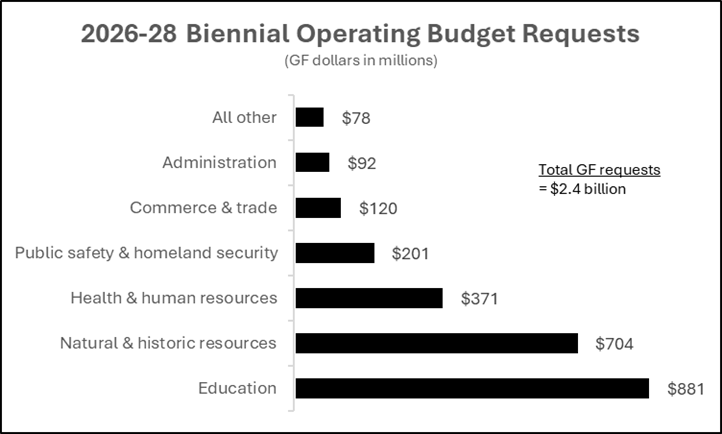
Education and HHR are usually at the top of that list, but it’s unusual to see Natural & Historic Resources among the top three. Below are just a few examples of the budget asks that were submitted by state agencies, including some sizeable requests in NHR.
- $442 million to fulfil wastewater needs assessment (WQIF)
- $212 million to fund free tuition for enrollees in the Virginia Military Survivors & Dependents Education Program (VSMDEP)
- $165 million for agriculture best management practices (BMP) and associated carveout programs
- $62 million to stabilize Virginia’s Correction Workforce through strategic compensation
- $58 million to fund the continued operations, management, and closure of the Shoosmith Brothers landfill through FY2028
- $50 million to fund strategic site due diligence and development through Virgina’s Business Ready Sites Program (VBRSP)
The next milestones in the budget process are the money committee retreats. The House Appropriations Committee (HAC) plans to meet in Virginia Beach on November 16 and 17, while the Senate Finance & Appropriations Committee (SFAC) convenes in Charlottesville later that week on November 19 and 20. Those meetings will give us each committee’s perspective on their economic and revenue outlook as well as budget priorities heading into the 2027 Session. On the day of the meetings, the presentations will be posted on their websites. Materials for the HAC can be found here and SFAC’s materials are available here. Enjoy!
VML Contact: Joe Flores, jflores@vml.org
Health & Human Resources
Behavioral health commission adopts study recommendations; more to come
In preparation for the 2027 General Assembly Session, the Virginia Behavioral Health Commission met on November 4 in Richmond to review and adopt several recommendations for possible legislation/budget amendments for the 2027 Session. The Commission includes members of the House and Senate and is chaired by Senator Creigh Deeds.
During 2026, the Commission studied issues regarding:
- Substance use services and supports in K-12 schools to include emphasis on restorative measures/intervention and provide more training, technical assistance, and oversight;
- Project BRAVO (Behavioral health Redesign for Access, Value and Outcomes) to include ways to improve service utilization, strengthen crisis oversight and appropriate uses as well as strengthening the transition of services under the redesign process, building provider capacity/training, and monitoring implementation success; and
- Behavioral health standards and implementation in local and regional jails, including ensuring implementation of minimum behavioral health standards (drafted by a workgroup in 2020) and directing needed resources to jails redesign training and monitoring.
The Commission adopted recommendations for all the issue areas except for ones related to jails; it is awaiting recommendations from a separate legislative study focused on the operations and potential changes to the oversight of the Board of Local and Regional Jails. That study was completed on November 1 but was not available to the Commission for its November 4 meeting. Potential recommendations from that study along with the Commission’s own recommendations will be taken up during a virtual Commission meeting to be held at 3:30 PM on December 8.
The slides outlining the Commission’s study options recommendations are available here >.
VML Contact: Janet Areson, jareson@vml.org
A snapshot of the Children’s Services Act (CSA) program in FY2026
Each year the Office of Children’s Services releases a data summary setting out the number of children and families served by the Children’s Services Act (CSA), types of services received and percentages of children receiving those services, and the cost of services.
CSA is a state supervised, locally administered program. Localities pay a share of costs for services and pay most administrative costs of the program. The local match for services is determined by a formula based on locality ability to pay; the average local match is approximately 33.5%, and ranges from a low of 16.98% (Russell County) to a high of 53.0% (Alexandria). Different types of services have different match requirements.
In Fiscal Year 2026, the CSA program served 16,815 children and families (unduplicated count) across Virginia. The combined state and local budget for the program was more than $665 million. Once again, private day special education led with the highest percentage of expenditures, making up 45 percent of expenditures for 29 percent of the children served in the program. Community-based services, including intensive in-home/behavioral therapies/assessments/parent coaching had the higher percentage of participants with 71% of the CSA census, but only 13% of the expenditures.
The CSA annual report can be found in the November 5 State Local Advisory Team (SLAT) agenda here >.
VML Contact: Janet Areson, jareson@vml.org
Housing
General Assembly’s local government committees hold joint retreat focused on housing issues
On October 23, members of the Senate Local Government Committee and House Counties, Cities and Towns Committee gathered for a joint retreat in Henrico County. While the committees oversee all legislative issues impacting local government, the retreat focused on housing issues across the Commonwealth.
Using the housing survey data provided by VML members, VML staff gave a high-level summary of local housing policy and housing approval activity. The data highlighted that localities across the Commonwealth are approving new housing units and implementing creative strategies to encourage housing development. At the same time, many localities reported increased strain on staff capacity as they work to implement the numerous state housing policy changes enacted in recent years.
Committee members also heard presentations on the spectrum of strategies that localities are implementing to address the housing needs of their communities, including land banks, transit-oriented development, and affordable housing development from the perspective of localities, non-profits, and developers.
The retreat concluded with committee members sharing their takeaways and closing thoughts. Many members emphasized an understanding of the value of equipping local governments with tools to address housing issues rather than mandating a one-size-fits-all approach to policies.
While it was encouraging to hear delegates and senators share this sentiment, it remains to be seen whether this will carry over as the legislators review and cast votes on legislation during the upcoming session.
VML Contact: Jessica Dennis, jdennis@vml.org
Transportation
Crime Commission receives report on automatic license plate readers
The Crime Commission met on November 5 and received a presentation summarizing a recently completed report on law enforcement use of automatic license plate reader (ALPR) systems in Virginia.
The report was required by legislation enacted in 2025 that established several requirements governing law enforcement use of ALPR technology. It incorporates data collected through a statewide survey distributed earlier this year to all Virginia law enforcement agencies.
Key findings from the report include:
- No state currently has a complete ban on ALPR systems.
- The survey for the report was sent to all Virginia law enforcement agencies (359 agencies) and had a 98% response rate. Agencies surveyed included county, city, town, sheriff departments, universities, and Viriginia State Police.
- Fifty-four percent of responding agencies (191 agencies) reported using ALPR technology.
- Most of the agencies surveyed reported overall compliance with the current ALPR requirements.
- Twenty agencies reported known violations of ALPR data usage. According to the presentation, seven cases involving alleged violations are currently pending in General District Court.
The meeting’s discussion was limited to the presentation, with Chair Charniele Herring asking members to limit questions to the data included in the presentation and accompanying report. However, much of the conversation centered on potential policy considerations. Topics raised by commission members included discussion of the consequences for law enforcement officials who violate ALPR data policies, discretion available to Commonwealth’s Attorneys when pursuing violations, and whether additional limits should be placed on access to ALPR data.
The Crime Commission is scheduled to meet again on Tuesday, November 10 at 3:15 PM. While the agenda is not currently available, Chair Herring indicated the meeting will include discussion of policy and potential legislative recommendations for 2027.
VML Contact: Jessica Dennis, jdennis@vml.org
Education
Joint subcommittee hears presentation on K-12 funding formula analysis
The Joint Subcommittee on Elementary and Secondary Education Funding met for the first time in two years on Monday, October 26. The meeting was brief but included two presentations – one outlining the goals and purpose of the subcommittee and the other summarizing the request for proposal (RFP) process being conducted by the Department of Education under the direction of State Superintendent Jenn Conway.
As stipulated in the 2026 budget, the state superintendent must conduct an RFP process to select a third party to assess the feasibility of redoing the K-12 funding formula. It was revealed at the meeting that the RFP process is currently proceeding with two task forces (stakeholder and technical) advising throughout. The third-party organization will hopefully begin analyzing the funding formula in January with the process expected to last as few as six months, and possibly as many as 24 months.
VML will be following the process carefully and will continue to update members.
VML Contact: Josette Bulova, jbulova@vml.org
Elections
Voter registration workgroup makes progress on draft report
The Back-End Automatic Voter Registration workgroup met for the fifth time on Wednesday, October 28. At this meeting, the workgroup’s draft report was presented, and members made comments and changes to the report. This group will continue to work on the draft report which will be finalized and presented to members of the House and Senate Privileges and Elections Committees at the end of November.
VML continues to monitor this workgroup and will provide further updates following the publication of the full report.
VML Contact: Josette Bulova, jbulova@vml.org